
Desert Safari During Ramadan in Abu Dhabi: What Changes and What Does Not
The safari runs, the timings move later, and the camp is quieter than at any other point in the season. Here is what actually changes, including the part most pages avoid saying out loud.
- 5 min read
- From AED 35
- Timings shift later
Two questions arrive every Ramadan, usually within a sentence of each other. Does the safari still run, and is it disrespectful to go.
Yes to the first, no to the second — and the honest version of both answers has some detail in it that most operators skip, particularly around the evening programme. This page gives you all of it before you book rather than at the camp gate.
The safari runs — the clock moves
The evening safari operates throughout Ramadan. What changes is the shape of the evening: pickup moves later, the dune bashing and sunset stop sit in the same golden hour they always do, and the food at the camp is served after maghrib rather than before it. Nobody eats in front of anybody who is fasting.
Because maghrib moves through the month, the exact pickup time moves with it. We give you the time for your specific date when you book — it is not the same in the first week as the last.
Morning and overnight trips run normally. The overnight is a particularly good choice during Ramadan: you reach the camp for iftar, the night is quiet, and suhoor before dawn in open desert is something most visitors never get to do.
Ramadan follows the lunar calendar and moves about eleven days earlier each year, so it is expected in February and March in 2027, with the exact start confirmed by moon sighting rather than by any calendar we could print here.
The bit most pages will not tell you
Here is the thing every “Ramadan desert safari” page seems to leave out: the entertainment programme is adjusted during Ramadan, in line with local practice. Music and dance performances are not treated the same way in this month as in any other, and what runs varies from year to year and from camp to camp.
We are not going to sell you a full tanoura-and-fire-show evening and then explain the difference once you are sitting on the sand an hour from the city.
What we do instead: when you message us with your date, we tell you exactly what is scheduled to run that night. If the programme is reduced, you hear it before you agree to anything and can move the booking to after Eid if you would rather.
What does not change: the dunes, the dune bashing, the camels, the sandboarding, the sunset, the food, the coffee and the fire. That is most of the evening, and for a lot of guests the quieter version is the better one.
Breaking the fast in the desert
It is one of the better places in the Emirates to do it. Tell us when you book and we time the trip so you are at the camp, or on the dunes just short of it, as maghrib arrives.
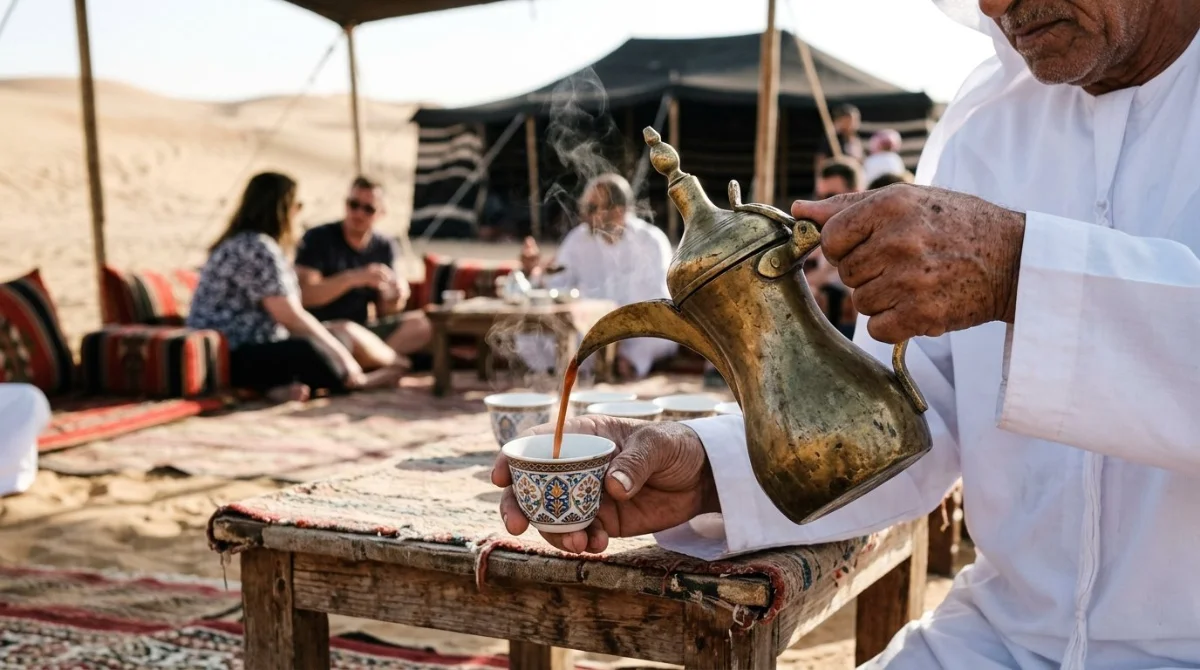
Dates and Arabic coffee first, the way it is done everywhere here, then the buffet opens: the live grill with chicken and lamb, rice, curries, hot vegetable dishes, the full mezze table, salads, fruit and sweets. There is a prayer area at the camp, and out there the qibla is roughly west-north-west, around 260 degrees.
On the overnight package, suhoor before first light sits naturally with the trip — the camp is at its quietest, the air is cold and clean, and dawn on empty dunes is a genuinely good way to start a fasting day.
There is no alcohol at the camp at any time of year, and no pork on the buffet, which for most families is one less thing to think about.
You are not intruding on anything
Visitors are not expected to fast and nobody will ask you whether you are. Hotels and most restaurants serve normally through the day, the shopping centres are open, and the city runs on shorter working hours rather than shutting down.
The one piece of ordinary courtesy: eating, drinking and smoking openly in the street during daylight is still considered discourteous, so people do it indoors. On the safari this looks after itself, because the drive out is in the late afternoon and the food is at the camp after sunset.
Take water in the car and drink it discreetly if you need to — no driver is going to mind, and dehydration in this climate is not a point of principle.
The atmosphere in Abu Dhabi during Ramadan is worth experiencing on its own terms: the city is at its most sociable after dark, and the desert on a Ramadan night is quieter than at any other point in the season.
Weather, prices and the drive
Prices do not change. Self-drive from AED 35, shared coach AED 50, hotel pickup AED 100, private car AED 599, overnight AED 450 — the same as any other night, VAT included. No deposit, no card details, no payment link. You agree one total on WhatsApp and pay at the camp. Full list on prices and timings.
The weather is on your side. With Ramadan falling in late winter and early spring for the next several years, you get comfortable days and cold clear nights — among the best desert conditions of the whole year. Bring a jacket for the camp.
The camp is at Al Khatim, about an hour from the Corniche and forty minutes from Zayed International.
Eid is the opposite of Ramadan for demand. The days immediately after are among the busiest of the year, so if your trip lands there, message us two or three weeks ahead.
Ramadan safaris — your questions
Do desert safaris run during Ramadan in Abu Dhabi?
Yes. The evening safari runs through Ramadan with the timings shifted so the camp meal falls after maghrib rather than before it. Morning and overnight trips run as usual.
Will the shows still run during Ramadan?
The entertainment programme is adjusted during Ramadan in line with local practice, and exactly what runs varies from year to year. We tell you what is scheduled for your specific date when you book, rather than promising a full show programme and disappointing you at the camp.
Do I have to fast if I am visiting during Ramadan?
No. Visitors are not expected to fast, hotels and most restaurants serve normally, and nobody will question you. Eating, drinking or smoking openly in the street during daylight is still considered discourteous, so people generally do it indoors.
Can I break my fast at the desert camp?
Yes – tell us when you book and we time the trip so you are at the camp for maghrib. Dates and Arabic coffee come first, the buffet opens after, and there is a prayer area at the camp.
Is the desert quieter during Ramadan?
Noticeably, in the first weeks. Fewer tour groups book, the evenings run later, and the camp has more room in it – which for a lot of guests is the whole appeal.
Are the prices different during Ramadan?
No. The same package prices apply, VAT included, with no deposit and no card details taken. You agree one total on WhatsApp and pay at the camp.
Read next
Package prices and start times are on prices and timings, prayer arrangements at the camp on the prayer times page, and the food station by station on the BBQ menu. For the month-by-month weather, see best time to go.
Send us your date and we will tell you exactly what runs
Including what the evening programme looks like that night, and the pickup time worked back from maghrib. If the answer is that you would enjoy it more after Eid, we will say that too.