
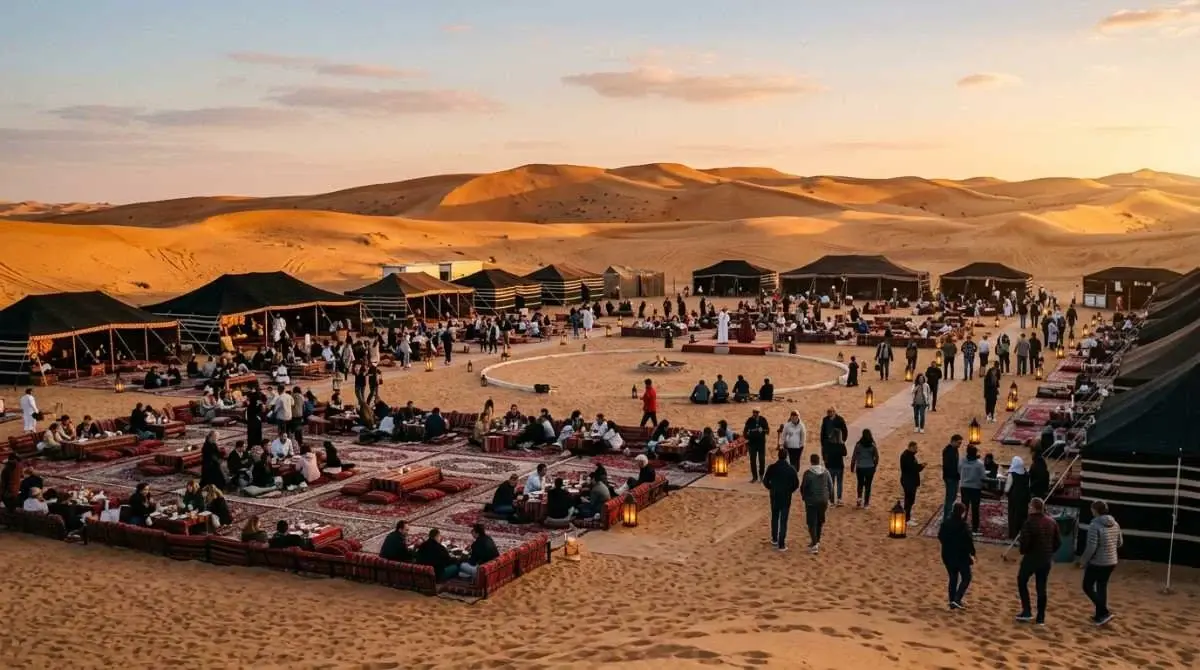
Desert Safari in February: The Most Even Month of the Year
26.5°C by day, 15.9°C at night — a gap of 10.6 degrees, the narrowest on the calendar. February is the month you dress once at three in the afternoon and never think about it again.
- 8 min read
- Al Khatim Desert
- Runs every day
- Same price all year
Every month here has a gap between its afternoon and its midnight. January’s is 10.7 degrees and almost all of it falls after sunset. April’s is nearly fourteen. February’s is 10.6 — the smallest of the twelve — and that single number is what makes it the easiest month to spend an evening in the desert.
It is not the most dramatic month. January has the clearer sky, March has the longer light, June has the later sunset. What February has is the absence of anything you need to manage.
The short version
It asks the least of you of any month. 26.5°C in the afternoon, 15.9°C at night. One fleece covers the whole evening. Nobody is managing heat and nobody is shivering.
The light has come back. Sunset runs 6:08 to 6:24 PM. After a three o’clock pickup that is nearly two hours of dune time in daylight, against roughly one in December.
The sea is at its coldest. About 21.1°C — the year’s low point, and a genuine surprise to anyone planning beach mornings and desert evenings in the same trip.
Peak season, evenly spread. No New Year spike, no public-holiday cluster. Just consistently full, which means booking a few days ahead rather than the same afternoon.
Watch the Ramadan calendar. It moves earlier every year and currently drifts through late winter. It changes what runs in the evening, not whether we run.
What February actually looks like in numbers
Official Abu Dhabi climate normals, with January and March either side.
| Measure | January | February | March |
|---|---|---|---|
| Average daytime high | 24.5°C | 26.5°C | 29.7°C |
| Average overnight low | 13.8°C | 15.9°C | 17.5°C |
| Day–night gap | 10.7°C | 10.6°C, the year’s narrowest | 12.2°C |
| Rainfall | 12.5 mm | 8.1 mm | 12.9 mm |
| Sunset, 1st | 5:46 PM | 6:08 PM | 6:25 PM |
| Sunset, last day | 6:07 PM | 6:24 PM | 6:38 PM |
| Sea temperature | 22.7°C | 21.1°C, the year’s coldest | warming |
Two rows carry the month. The gap row is why February feels effortless — and the rain row is a quiet surprise, because February is drier than both of the months it sits between.
Note what the sunset rows do. January ended at 6:07 PM and February opens at 6:08. The evening keeps growing all month and hands over to March at 6:25. From here to June it does not stop.
Why the narrowest gap on the calendar matters more than the average
Most weather advice for the desert quotes an average temperature, which is close to useless for a trip that starts at three in the afternoon and ends at half past nine at night. What actually determines your evening is the spread — how far the temperature travels while you are out in it.
February travels 10.6 degrees, less than any other month. In practical terms that means the fleece you put on shortly after sunset is the last decision you make. There is no second layer to fetch, no point where the camp splits into people who brought a jacket and people who did not.
Compare it with April, which sounds like a better month and is not, for this trip. April runs 35.0°C down to 21.1°C — a 13.9-degree fall, with a genuinely hot start. Or May, which travels a full fifteen degrees. February is the only month where the afternoon and the night are both comfortable without either of them being remarkable.
That is why it is the month we recommend to people who ask once and do not want to think about it again.
Two hours of dune light instead of one
The other thing February quietly fixes is the shape of the evening. Pickup is 3:00 to 3:30 PM year round. In December, sunset at 5:34 PM means you reach the dunes with barely an hour of daylight and the whole camp programme happens in the dark.
By February, sunset has moved to 6:08 PM at the start of the month and 6:24 by the end. You get the drive out in daylight, a proper unhurried dune session, time to walk up a ridge before the light goes, and then still a full dark evening at the camp for the fire and the shows.
It is the first month of the year where both halves of the trip get enough room.
The month with the coldest sea
This one catches people every year. February feels like the warmest of the winter months, so visitors plan a beach morning and a desert evening on the same day. The sea does not cooperate: at roughly 21.1°C it is the coldest water of the year.
The reason is lag. Water holds and releases heat far more slowly than air, so the sea bottoms out about two months after the air does. December air is cold; February water is cold. By the time the sea is genuinely pleasant, in May and June, the afternoons are the problem instead.
If you want both in one trip, April is the compromise — 25.2°C water and evenings that still work. In February, take the desert and leave the swimming.
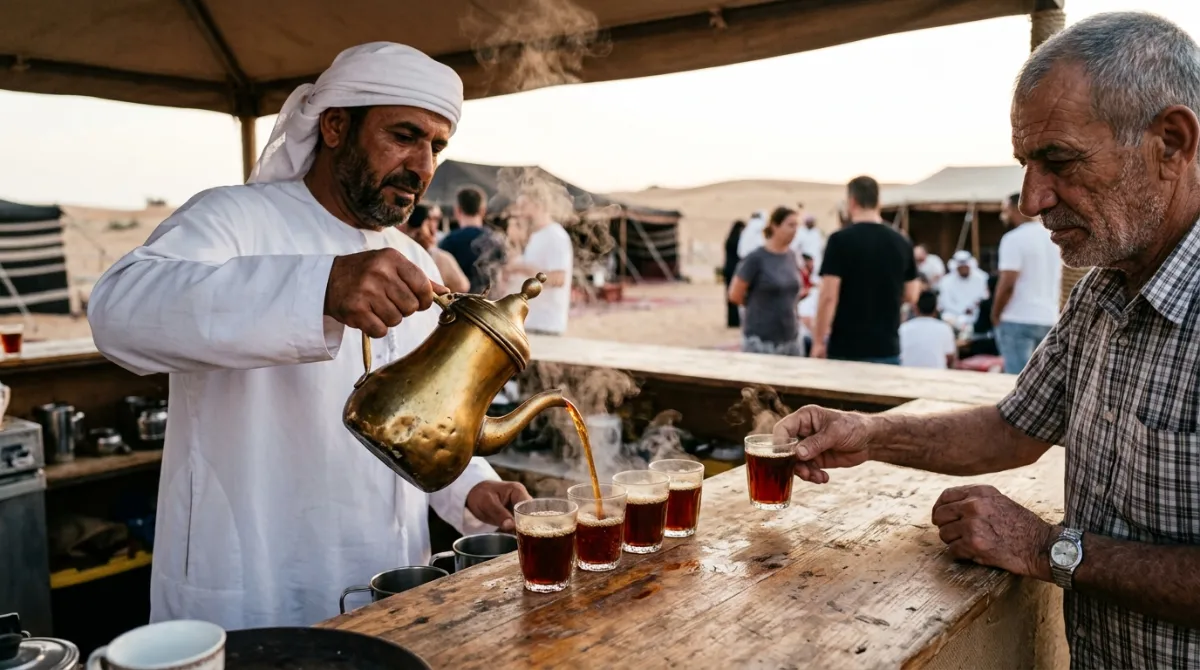
Ramadan, and what it changes
Ramadan shifts about eleven days earlier each year against the Western calendar, so it drifts steadily through late winter and spring. Depending on the year, some or all of February can fall inside it.
What changes during Ramadan is the entertainment programme and the meal timing: the live shows follow the religious-holiday schedule, and dinner moves with iftar. What does not change is the safari itself — the dune drive, the camel ride, the sandboarding, the camp and the buffet all run.
It is also, for some guests, the better version. A Ramadan evening at the camp is quieter and the dinner has a different character to it. Tell us your date on WhatsApp and we will tell you exactly what runs that night rather than making you guess.
What to wear in February
Less than January and more than March. The list is short because the month is forgiving:
| Layer | Why |
|---|---|
| T-shirt or light long sleeve | 26.5°C afternoons are properly warm |
| A fleece or hoodie | Goes on around sunset and stays on |
| Long trousers | Better on a camel, warmer after dark |
| Closed shoes and socks | Sand is cool by evening |
| Sunglasses | The low sun is straight ahead on the drive out |
| A light jacket for children | They feel 15.9°C sooner than you do |
A heavy winter jacket is overkill in February and you will end up carrying it. One warm layer over a t-shirt is the whole answer. There is more on the what to wear guide.
Morning or evening in February?
The evening, for most people — it is the full programme, and February gives it the best conditions of the year. From AED 35 a person if you drive out yourself.
February is also the easiest month of the year to make a case for the morning. At 15.9°C the dawn is cool rather than cold, unlike January, and the light is still winter-clean. The private morning drive is AED 799 for the car. If you have ever wanted the dunes to yourselves without suffering for it, this is the month.
What a February safari costs
There is no peak-season surcharge. February costs exactly what August costs — the difference between the two months is the pickup time and the jacket, not the bill.
| How you travel | Price | Unit |
|---|---|---|
| Self-drive to the camp | AED 35 | per person |
| Shared bus from Al Wahda or Mazyad Mall | AED 50 | per person |
| Hotel pickup, shared vehicle | AED 100 | per person |
| Private car, up to seven guests | AED 599 | per car |
| Private Land Cruiser | AED 800 | per car |
| Morning safari, private | AED 799 | per car |
Add-ons at the camp: quad bike AED 100 single or 150 double, VIP majlis seating AED 50 per person, long camel ride AED 300, falcon photo AED 30, extra dune bashing AED 150 per vehicle.
No deposit and no card details. You pay on arrival, cash or card, and you can cancel free up to twenty-four hours before pickup.
Who February suits, and who should pick another month
Book February if you want one comfortable evening with nothing to plan around; if you are bringing grandparents and small children on the same trip; if you want daylight on the dunes as well as a dark camp; or if you are visiting once and want the highest chance of a straightforwardly good night.
Pick another month if you want to swim, because this is the coldest water of the year; if you are chasing the absolute clearest sky for astrophotography, where January edges it; if you want a late start, which means June or July; or if you want the camp quiet, in which case May and September are emptier.
February questions we get on WhatsApp
Is February a good month for a desert safari in Abu Dhabi?
It is the most comfortable month of the twelve. Official normals give February a 26.5°C average high and a 15.9°C average low — a gap of 10.6 degrees, the narrowest of any month. The afternoon never overheats and the evening never turns bitter, so you dress once and you are right for the whole trip.
How warm is Abu Dhabi in February?
An average daytime high of 26.5°C and an average overnight low of 15.9°C. That is two degrees warmer than January in both directions, which is enough to change how the evening feels without touching the afternoon.
What time is sunset in February?
From about 6:08 PM on the 1st to about 6:24 PM on the 29th. That gives you close to two hours of dune light after a three o’clock pickup, rather than the single hour midwinter allows.
Do I still need a jacket in February?
A light one, yes. 15.9°C in open desert after dark is cool enough to notice, but it is two degrees above January and it does not have the same bite. A fleece is usually enough; a jacket is comfort rather than necessity.
Can I swim in the sea in February?
Not comfortably. February has the coldest sea of the year at about 21.1°C, which catches out people who assume the warmest-feeling month has the warmest water. The sea lags the air by roughly two months.
Does it rain in February?
About 8 mm across roughly two days — less than January and less than March. February sits inside the year’s small rainy window but is the driest of the three winter months in it.
Is February busy?
Yes, steadily. It is peak season without the spikes: no New Year rush, no National Day, just a full calendar of good weather that visitors have worked out. Book two to three days ahead for a shared seat and closer to a week for a private car on a weekend.
Does Ramadan affect the desert safari?
It can, depending on the year. Ramadan moves about eleven days earlier each year, so it drifts through late winter and spring. During Ramadan the live shows follow the religious-holiday schedule and dinner timings shift with iftar. The dune drive, camel ride and camp itself run as normal. Ask us on WhatsApp for your specific date and we will tell you exactly what runs.
Is February better than January or March?
For an even, comfortable evening, yes. January is colder and clearer — better for stars and photography. March is warmer with longer light — better if you want daylight on the dunes. February sits between them and asks the least of you.
The month either side
The January guide covers the coldest nights and the clearest air, and March — the equinox month, and the last one comfortable all day — sits on the other side. Every package and pickup time is on the price and timings page. All twelve months are compared on the best time to go page.
Tell us your February date and we will hold it
Send the date, the package and how many of you there are. A real person replies, usually within a few minutes. If your date falls inside Ramadan we will tell you exactly what runs that evening.
Al Khatim Desert · Abu Dhabi | Pay on arrival · Free cancellation · No deposit