
Desert Safari in March: The Last Month That Works All Day
29.7°C afternoons, 17.5°C nights and the equinox in the middle of it. March is the last month you can spend outdoors from breakfast to bedtime — and the closing month of the clear-sky season.
- 8 min read
- Al Khatim Desert
- Runs every day
- Same price all year
March is the hinge of the Abu Dhabi year. It opens looking like February and closes looking like April, and somewhere around the twentieth the sun crosses the equator and day and night come out level at twelve hours each.
It is also the last month on the calendar where the afternoon is not something to plan around. From April onwards every recommendation on this site becomes “book the evening”. In March, that is a preference rather than an instruction.
The short version
The afternoon still works. 29.7°C is the top of the comfortable band. You can walk a dune at two in the afternoon in March. You cannot in April.
The evening is mild, not cold. 17.5°C at night. One warm layer, and the jacket can stay in the room for the first time since October.
Day and night level out. Around the 20th the equinox gives you twelve hours of each. Sunset runs 6:25 to 6:38 PM — long daylight on the dunes and still a fully dark camp.
It is the wettest month on paper and it barely matters. 12.9 mm across roughly three days. Twenty-eight dry days out of thirty-one.
The clear-sky season ends here. March is the last month of the October-to-March stargazing window before the air starts to soften.
What March actually looks like in numbers
Official Abu Dhabi climate normals, with February and April either side.
| Measure | February | March | April |
|---|---|---|---|
| Average daytime high | 26.5°C | 29.7°C | 35.0°C |
| Average overnight low | 15.9°C | 17.5°C | 21.1°C |
| Rainfall | 8.1 mm | 12.9 mm, the year’s highest | 5.2 mm |
| Sunset, 1st | 6:08 PM | 6:25 PM | 6:39 PM |
| Sunset, last day | 6:24 PM | 6:38 PM | 6:51 PM |
| Daylight | ~11 h 20 m | ~12 h at the equinox | ~12 h 40 m |
| The afternoon | Comfortable | Comfortable, warm by month end | Genuinely hot |
The row that decides everything is the first one. February to March is a three-degree step and you barely notice it. March to April is more than five, and that is the step where the daytime stops being available. Nothing else on this table moves as sharply.
The rainfall row deserves its own sentence, because “the wettest month of the year” sounds alarming until you see the number. 12.9 mm is roughly half an inch, spread across about three days.
The last month you can use the whole day
Almost everything written about desert safaris assumes you are only going out in the evening, and for eight months of the year that assumption is correct. March is one of the few months where it stops being true.
At 29.7°C you can stand on a dune at midday. It is warm, not punishing. You could go out to Al Khatim in the morning, spend a couple of hours on the sand, drive back for lunch and still do the evening programme. In May, at 39.6°C, that itinerary would be a genuinely bad idea.
The practical version for most visitors: March is the month where the morning safari and the evening safari are both reasonable choices rather than one obvious one and one specialist one. It is also the month where an unhurried sunset walk up a ridge is pleasant instead of a heat calculation.
Watch the last ten days though. By the end of March the afternoons are pushing toward April and the difference is noticeable on the ground.
What the equinox actually changes
Around 20 March the sun crosses the equator and Abu Dhabi gets twelve hours of daylight and twelve hours of dark. From that date until September, the days are longer than the nights.
For a desert safari the equinox is a useful marker rather than an event. Sunset sits at roughly 6:30 PM, which is close to the ideal shape for the trip: a three o’clock pickup gives you enough daylight to see the dunes properly, and there is still a genuinely dark sky by the time dinner and the shows begin.
Either side of March that balance tips. In December you reach the dunes with an hour of light. In June the sun is still up at 7:15 PM and children are asleep before the sky goes properly black.
The wettest month, and why it barely registers
March averages 12.9 mm of rain, which makes it the wettest month on the Abu Dhabi calendar. The annual total is so small that this is not the warning it sounds like.
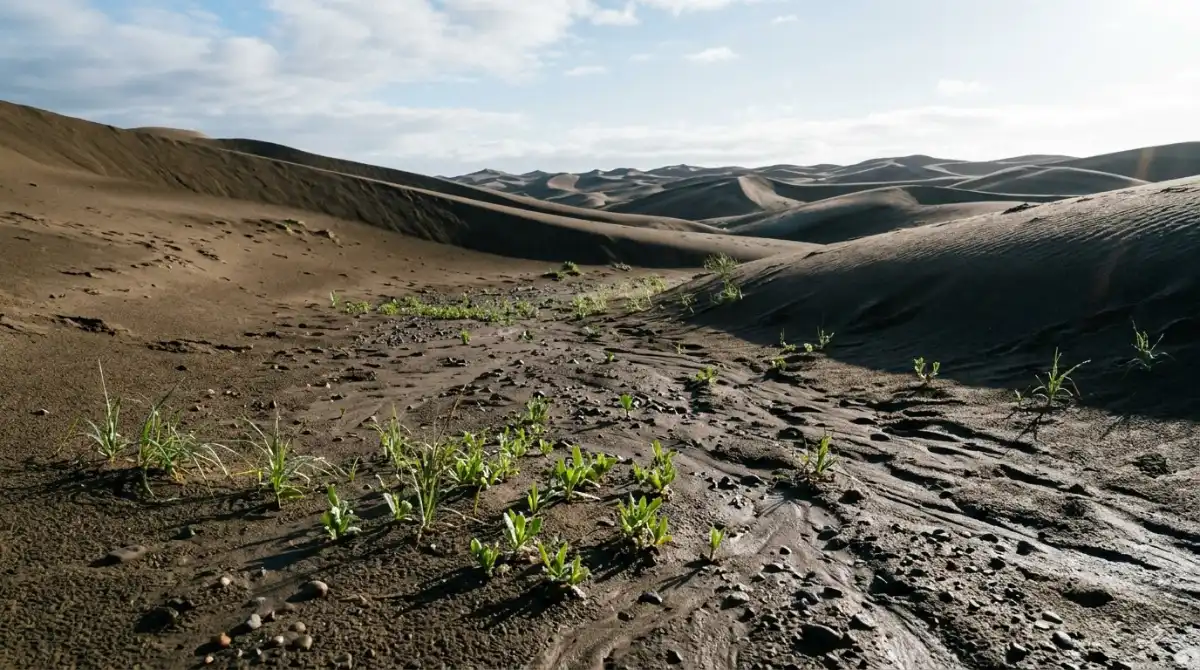
Spread across about three days, it means most March visitors see no rain at all. What the winter rain does leave behind is worth planning for: for a few weeks after a decent shower, thin green growth comes up in the low ground between the dunes. It is not lush and it does not last, but it is the only time of year the desert here is anything other than sand-coloured.
If a track is running slick our drivers change the dune section, the same way they adjust for soft sand or wind. If a night is genuinely unsuitable we move you and it costs nothing.
The clear-sky window closes in March
The clean-air season runs October to March. There is no dust season in winter — the shamal belongs to early summer — and no heat haze off the sand, so distant ridgelines stay sharp and the sky goes properly black.
March is the last month of it, and it has an advantage over the rest of the window: at 17.5°C you can lie back on the sand and look up without a jacket, which you cannot do in January at 13.8°C. Only October, at 23.7°C, is more comfortable for it.
By April the air begins to soften and the season is over until autumn. If stargazing is the reason you are coming, March is your last straightforward month. There is more on the stargazing guide.
What to wear in March
The shortest packing list of the winter half of the year:
| Item | Why |
|---|---|
| T-shirt | 29.7°C afternoons |
| One fleece or hoodie | 17.5°C after dark is mild, not cold |
| Long trousers | Better on a camel and a quad; warmer late on |
| Closed shoes and socks | Sand and sandals do not get along |
| Sunglasses and sunscreen | You are out in real daylight in March, unlike December |
| A light layer for children | They still feel the drop before you do |
March is the first month since October where you can genuinely leave the jacket behind. By April you will not want one at all.
Ramadan, and what it changes
Ramadan shifts roughly eleven days earlier each year against the Western calendar, so it drifts through the late-winter and early-spring months. Depending on the year, part or all of March can fall inside it.
What changes is the entertainment programme and the meal timing — the live shows follow the religious-holiday schedule and dinner moves with iftar. What does not change is the safari: the dune drive, the camel ride, the sandboarding and the camp all run as usual.
Send us your date on WhatsApp and we will tell you exactly what is running that evening rather than leaving you to guess from a calendar.
What a March safari costs
Nothing on this list changes with the season. March costs the same as July. There is no peak-season surcharge and no weekend premium.
| How you travel | Price | Unit |
|---|---|---|
| Self-drive to the camp | AED 35 | per person |
| Shared bus from Al Wahda or Mazyad Mall | AED 50 | per person |
| Hotel pickup, shared vehicle | AED 100 | per person |
| Private car, up to seven guests | AED 599 | per car |
| Private Land Cruiser | AED 800 | per car |
| Morning safari, private | AED 799 | per car |
Add-ons at the camp: quad bike AED 100 single or 150 double, VIP majlis seating AED 50 per person, long camel ride AED 300, falcon photo AED 30, extra dune bashing AED 150 per vehicle.
No deposit and no card details. You pay on arrival, cash or card, and you can cancel free up to twenty-four hours before pickup.
Who March suits, and who should pick another month
Book March if you want the whole day rather than just the evening; if you want a warm evening without a jacket for the first time since autumn; if you are combining the desert with city sightseeing that involves standing outdoors; if you want the last of the clear-sky season with a comfortable night to enjoy it in; or if you want to see the desert with something green in it.
Pick another month if you want to swim, since the sea is still climbing out of its February low; if you want the very latest sunsets, which arrive in June; if you need absolute rain certainty, in which case May onwards is bone dry; or if you want the quietest camps, which are May, June and September.
March questions we get on WhatsApp
Is March a good month for a desert safari in Abu Dhabi?
It is one of the best, and it is the last month where the whole day works rather than only the evening. Normals give March a 29.7°C average high and a 17.5°C average low, with sunset stretching to 6:38 PM by month end. The first three weeks are excellent; the last ten days start to lean into April.
How hot is Abu Dhabi in March?
The average daytime high is 29.7°C and the average overnight low is 17.5°C. That is the top of the comfortable band by day and a mild evening by any standard — the last month before the afternoon becomes something you plan around.
Is March the wettest month in Abu Dhabi?
On paper, yes. March averages 12.9 mm, marginally more than January’s 12.5 mm. In practice that is about three days of light rain in a month of thirty-one, and inland Al Khatim usually gets less than the coast. Roughly twenty-eight days are dry.
What is the equinox and does it matter for a safari?
Around 20 March, day and night are the same length — roughly twelve hours each. For a desert safari it means sunset sits close to 6:30 PM, so a three o’clock pickup gives you a long stretch of daylight on the dunes and still a properly dark camp for the shows and the stars.
Is March good for stargazing?
It is the closing month of the clear-sky window that runs from October. Nights are still dark and mild at 17.5°C, and the summer haze has not arrived. By April the air starts to soften and the stargazing season is effectively over until autumn.
What should I wear in March?
A t-shirt for the 29.7°C afternoon and one warm layer for the evening. A fleece is plenty for 17.5°C. Long trousers and closed shoes as always. March is the first month of the year where you can genuinely leave the jacket behind.
Does Ramadan fall in March?
It depends on the year. Ramadan moves about eleven days earlier each year, so it drifts through the late-winter and early-spring months. During Ramadan the live shows follow the religious-holiday schedule and dinner moves with iftar, while the dune drive, camel ride and camp run as normal. Send us your date and we will tell you what runs.
Is there a sandstorm season in March?
No. The dusty shamal season belongs to early summer, roughly June to mid-August. March can get a windy afternoon like any month, but the idea of a March sandstorm season is a myth that gets repeated on travel blogs.
Is March or April better?
March, for almost everyone. They share the same evening quality but March keeps a comfortable afternoon and April does not — April’s average high is 35.0°C against March’s 29.7°C. April buys you a later sunset and warmer sea; March buys you a day you can actually spend outdoors.
The month either side
The February guide covers the most even month of the year, and April — where the afternoon stops working and the evening gets better — is next. Every package and pickup time is on the price and timings page. All twelve months are compared on the best time to go page.
Tell us your March date and we will tell you how the month is running
Send the date, the package and how many of you there are. A real person replies, usually within a few minutes. Early March and late March are noticeably different and we will say which one you are getting.
Al Khatim Desert · Abu Dhabi | Pay on arrival · Free cancellation · No deposit