Guide · Al Quaa & the dark sky
Stargazing in Abu Dhabi: Al Quaa and the Milky Way Season
Al Quaa is the darkest accessible sky in the country and every guide tells you to go there. Almost none of them mention that the Milky Way core is only above the horizon for part of the year — and that the best months are the ones you least want to be sleeping in a desert.
- Al Quaa: ~125 km, ~90 min
- Core season: roughly Feb–July
- New moon only
- No facilities at all
- Al Sadeem is 40 min away
Our overnight safari at Al Khatim is closer in and darker than the city by a long way — though Al Quaa is darker still.
The thing nobody says
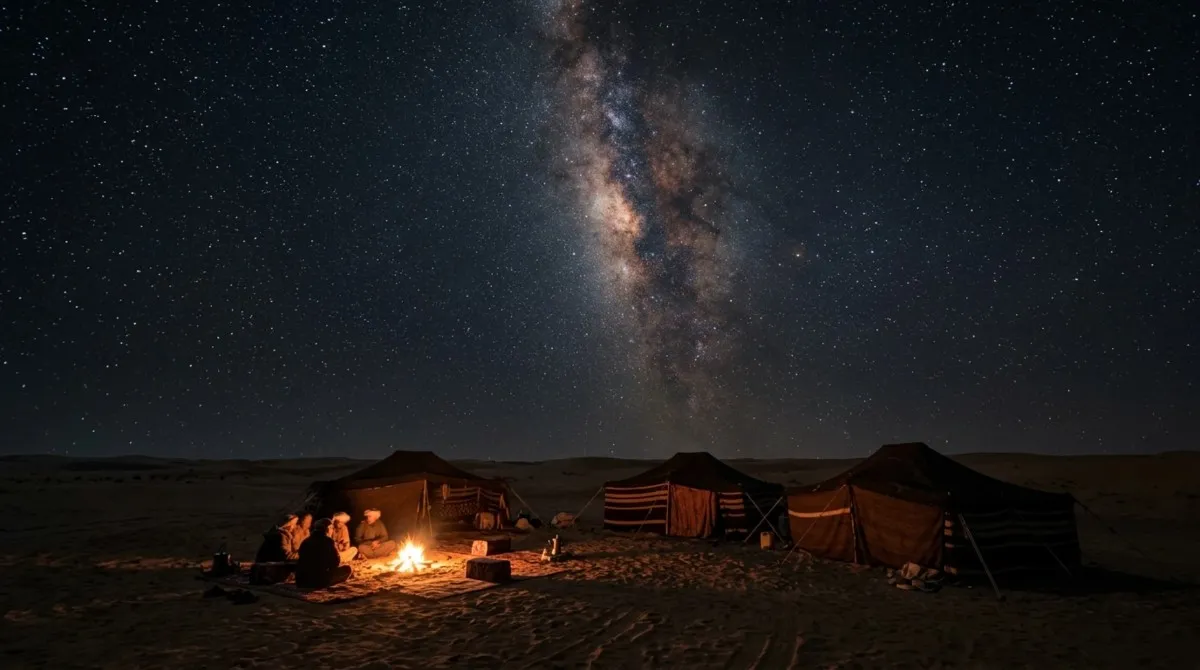
The Milky Way is not visible all year
This is the single most useful fact on this page and it is missing from almost every stargazing guide written about the UAE. Tourists arrive in January expecting the photograph they saw online and cannot understand why the sky looks empty.
| Months | Milky Way core | Comfort outdoors | Verdict |
|---|---|---|---|
| Nov – Jan | Below the horizon | Excellent | Beautiful night sky, stars and constellations — but not the galactic core |
| Feb – Mar | Rising before dawn | Excellent | The sweet spot. Core visible late, weather still cool |
| Apr – May | Good, after midnight | Getting warm | Very good if you can stay up |
| Jun – Jul | Best of the year | Brutal | The core is at its finest and it is 40°C at midnight |
| Aug – Oct | Fading through the season | Improving | Declining core, improving weather |
The trade-off, stated plainly
Best core, worst weather. Best weather, no core. February and March are the compromise — the core rises in the small hours and you can still sit outside comfortably. Astronomy groups here typically wrap up their public season in July, which tells you where the calendar really sits.
And whatever the month: go on a new moon. A bright moon washes out the sky more effectively than a nearby city does.
Al Quaa
Where it is and what is actually there
Al Quaa sits around 125 km from Abu Dhabi toward Al Ain — roughly ninety minutes. You come off at a large roundabout and follow a dirt road to a gated entrance.
It is dark because there is nothing near it: no settlement lighting, no industry, and unlike some other spots it is not under a flight path. You will see claims about its Bortle rating; we have not found a published measurement, so we are not going to quote a number at you. Check a light-pollution map yourself and you will see why it is the spot everyone names.
- VehicleA normal car handles the packed-sand approach. A 4×4 only if you intend to go into the dunes, which you should not do at night.
- FacilitiesNone. No toilets, no shop, no lighting, no water. Bring every single thing you will need.
- TimingAfter about 10 PM, once the twilight has fully gone. Check the moon phase first.
- CampingWidely practised in the cooler months. We could not find a clear published permit rule, so treat it as unsettled and check with the authorities rather than take our word for it.
- SafetyCamp beside your vehicle so nobody drives into your tent in the dark. Do not go off-road alone. Tell someone where you are.
Options
Al Quaa, an observatory, or a desert camp?
Three quite different nights, and the right one depends on how much effort you want to spend.
Al Quaa
Ninety minutes each way, nothing there, and the best sky in the country. Best for people who want to camp and photograph properly. Organised astronomy nights run there in season with telescopes and workshops, which solves the logistics.
Al Sadeem Observatory
Out at Al Wathba, around forty minutes from the city. A real observatory with telescopes and staff who know what they are pointing at. The obvious answer if you want astronomy without a night in the desert.
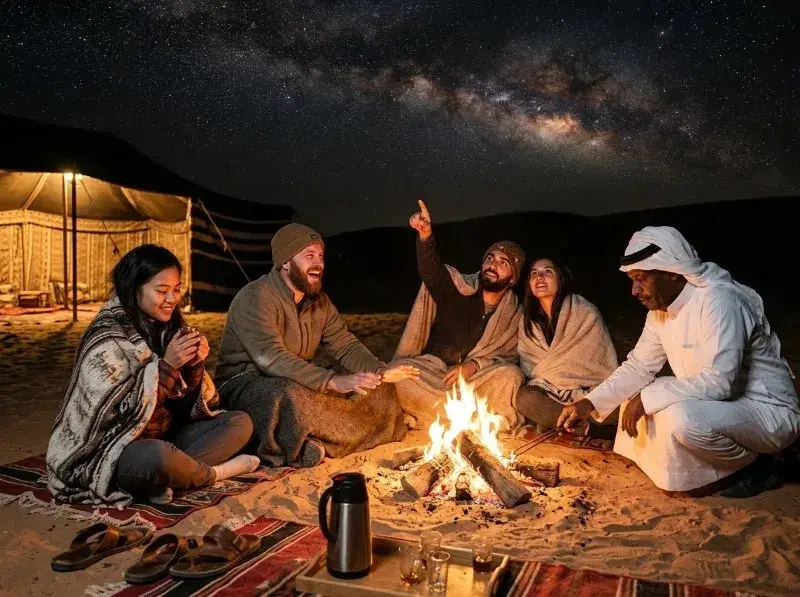
An overnight at the camp
Our overnight safari at Al Khatim, an hour out. Not as dark as Al Quaa — there is camp lighting — but once the day groups leave and the fire dies down, the sky out there is a long way from anything you see in the city. AED 450 with dinner, a bed and breakfast.
Just drive east
Anywhere an hour out along the Al Ain road on a new moon is dramatically better than the Corniche. Pull well off the road, kill your headlights, and give your eyes twenty minutes to adapt. That last part is the bit everyone skips.
Practical
What to bring, and what your phone will not do
You need nothing at all
The band of the Milky Way, the constellations and satellites crossing overhead are all naked-eye. Give yourself twenty minutes without looking at a screen and you will see several times more than when you arrived.
Phones will not capture it
Recent phones in night mode get something. For the photograph you have in your head you need a camera with manual control, a fast wide lens and a solid tripod. There is no shortcut.
Warm layers
The desert loses its heat fast after dark. Even in a month you would call hot, sitting still at 2 AM is cold. This catches out almost everyone the first time.
A red torch
White light destroys your night vision and everyone else’s. A red light, or red tape over a torch, keeps your eyes adapted. A star-identification app on the dimmest red night mode helps too.
FAQs
Stargazing in Abu Dhabi — your questions
When can you see the Milky Way in the UAE?
The bright galactic core is above the horizon roughly from February through July, and it is at its best in June and July — when it is also 40 degrees at midnight. February and March are the practical compromise. In November to January the core is not visible at all, though the rest of the night sky still is.
How far is Al Quaa from Abu Dhabi?
Around 125 km toward Al Ain, so about ninety minutes.
Do I need a 4×4 to get to Al Quaa?
No. A normal car handles the packed-sand approach. A 4×4 is only for going into the dunes, which is a bad idea at night.
Is there anything at Al Quaa?
Nothing. No toilets, no shop, no lighting, no water, no signal guarantee. Bring everything you need and take it away again.
Is camping at Al Quaa legal?
People camp there regularly in the cooler months. We could not find a clear published permit rule and we are not going to invent one — check with the authorities. UAE environmental law applies regardless: contained fires, no burning or burying waste.
What time should I go?
After about 10 PM once twilight is fully gone, and on a new moon. A bright moon ruins the sky faster than a distant city does.
Can my phone photograph the Milky Way?
Recent phones in night mode get something recognisable. For a real photograph you need manual controls, a fast wide lens and a tripod.
Where can I stargaze closer to the city?
Al Sadeem Observatory at Al Wathba, about forty minutes out, is the easy option with real telescopes and staff. Our overnight safari at Al Khatim, an hour out, is the middle ground.
Is the desert camp dark enough for stars?
Once the evening groups leave and the fire burns down, yes — genuinely dark, and a completely different sky from the city. Not as dark as Al Quaa, because a camp has lights. But you get dinner, a bed and no ninety-minute drive home at 3 AM.
Do I need a telescope?
No, and for the Milky Way a telescope is the wrong instrument — it is far too zoomed in. Your eyes, dark-adapted, are the right tool.
Is it safe out there at night?
Reasonably, with sense. Camp beside your vehicle so nobody drives into your tent, do not drive off-road alone in the dark, and tell someone where you are going.
When to come for the stars
The clear-sky window runs October to March. Within it, October is the only month with nights warm enough — 23.7°C — to lie back on the sand without a jacket, while January has the very cleanest air and the coldest nights. Summer haze closes the window; see the best time to go page. The rest of the desert, and what happens at the camp after dark, is on the Abu Dhabi desert page.Abu Dhabi at nightDesert photography spots
Sleep under it instead
The overnight safari puts you in the desert after everyone else has gone home — dinner, a fire, a bed and a sky the city has not seen in fifty years. AED 450.
Overnight Safari · Sunrise Safari · The Al Khatim desert · Timings & season