The desert Abu Dhabi safaris actually go to
The Al Khatim Desert, an Hour Inland From Abu Dhabi
Almost every desert safari sold in Abu Dhabi ends up here, and almost no page will tell you where “here” is. Al Khatim is the dune belt along the Al Ain road, inland from the city. This page is the version we wish existed when we started — distances, geology, wildlife, and an honest comparison with every other desert near Abu Dhabi.
- Along the E22 Al Ain road
- 45–60 minutes from the city
- Beginner-friendly dunes
- Not a protected area
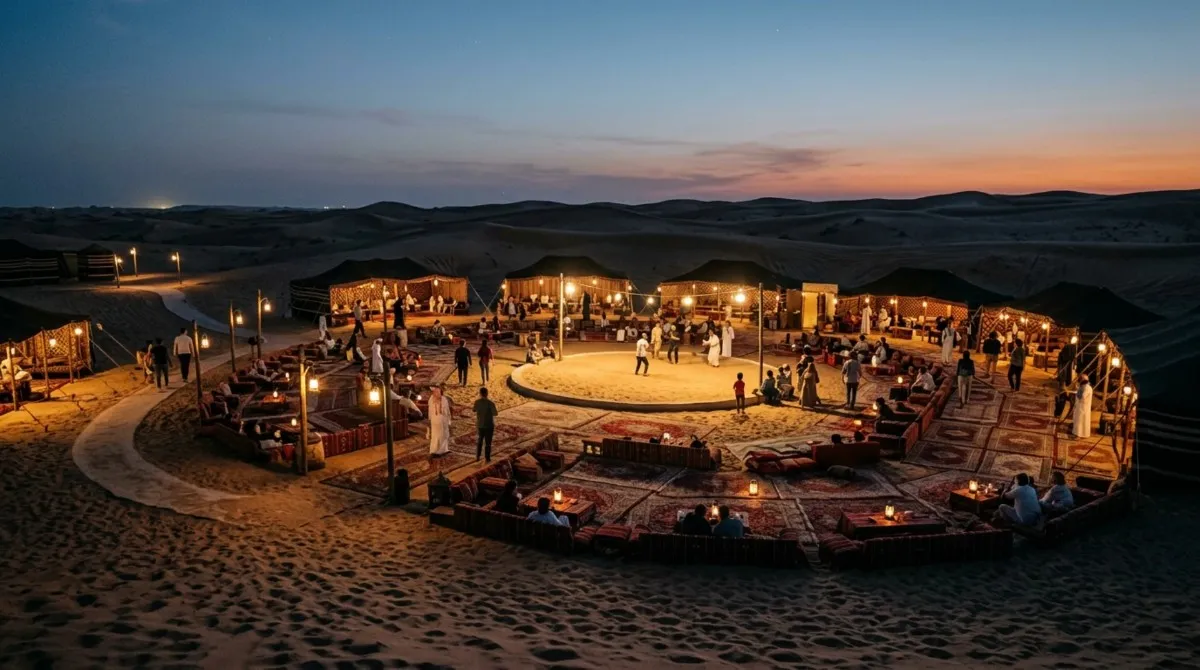
- Our camp is here
The distance dispute
Why Al Khatim is 50 km and 80 km at the same time
Look this up and you will find one source saying 45 to 50 kilometres and another saying 80. One operator page manages to print both figures in the same article. Neither is lying — they are measuring from different places.
| Measuring from | Straight line | By road | Drive time |
|---|---|---|---|
| Corniche / Abu Dhabi island | ~71 km | ~80–85 km | Around an hour |
| Khalifa City, Al Raha, Mussafah | ~47 km | ~50–60 km | 35–50 minutes |
| Zayed International Airport | ~45 km | ~50 km | Around 40 minutes |
| Yas Island or Saadiyat | — | ~70–80 km | 50–65 minutes |
What this means for your pickup
Operators quote the mainland figure because it is smaller and because most pickups start there. If you are staying on the Corniche or on Saadiyat, add fifteen or twenty minutes to whatever number you have been given. We tell you your actual pickup time the day before, based on where you are, rather than a generic one. If you are arriving by air rather than from a hotel, the airport row above is the one that matters — see the layover page for a same-day connection, or the stopover page if you are staying a night or more.
The landscape
What Al Khatim actually looks like
Not the Sahara, and not the Empty Quarter. This is a rolling dune field that starts almost at the edge of the tarmac and runs inland toward Al Ain, broken by flat gravel plains and shallow bowls scooped out by the wind.
The sand is fine and pale gold. It is not the iron-red sand you see in photographs from Lahbab on the Dubai side — that is a different geology entirely, and if red dunes are what you came for, this is not that place.
The dunes here are moderate. High enough that a Land Cruiser has something to work with and a sandboard has a real run, low enough that a first-timer is not terrified. That combination is the entire reason the safari industry settled here rather than somewhere more dramatic.
Where the sand came from
The shamal — the northerly wind that blows down the Gulf — has been carrying sand inland from the coast for a very long time. Parts of the Abu Dhabi dune system hold sand that predates the last ice age, more than nineteen thousand years old. Underneath it, alluvial valleys carry groundwater west from the Omani mountains, which is why anything grows here at all.
Wildlife
What lives out here — and what tour pages wrongly promise
You will see safari listings promising oryx and gazelle. Be sceptical. Those populations in the Emirates are almost entirely inside fenced reserves now, and Al Khatim is open desert on a public road. What you actually might see is smaller and, if you look properly, more interesting.
Ghaf trees
The national tree, standing alone at dune bases with roots going down thirty metres to reach water. If you see one on the drive out, that is a landmark, not scenery.
Camels, domestic
Herds belonging to local families, wandering loose along the roadside. There are no wild camels in Arabia. Drivers watch for them at dusk because they are a genuine road hazard.
Dhub and desert birds
The spiny-tailed lizard basking in the morning, cream-coloured coursers running rather than flying, and hoopoe larks. Best odds on a sunrise trip, worst on an evening one.
Oryx, gazelle, sand cat
They exist in the Emirates and they are magnificent. They are also in reserves or nocturnal and shy. If a tour promises you oryx on a standard evening safari, ask them where exactly.
Ghaf, arta, desert hyacinth and various salt-tolerant shrubs make up most of what grows. It looks like nothing from a moving car and like a great deal once you are standing still.
Choosing a desert
Al Khatim vs everywhere else near Abu Dhabi
Pick by how much time you have, not by which sounds most impressive. This is the table we would want if we were planning the trip ourselves.
| Where | From Abu Dhabi | Drive | What it is good for |
|---|---|---|---|
| Al Khatim | 50–80 km | 45–60 min | Beginner dune bashing, camps, sunset, a half day. Where nearly every Abu Dhabi safari runs, including ours. |
| Al Wathba Fossil Dunes | ~45 km | ~35 min | Free, walkable, no 4×4 needed, extraordinary geology. Protected — no driving, no riding, no climbing. |
| Sweihan | ~100 km | ~1 hr 15 | Bigger, steeper, softer sand. Experienced self-drivers only. Not a beginner venue. |
| Liwa & Moreeb | ~250 km | 2.5–3 hrs | The Empty Quarter. Moreeb is around 300 m with a 50-degree face. A full day or an overnight, never an evening trip. |
| Lahbab / Big Red | ~180–200 km | ~2 hrs | Dubai’s red sand and quad rental strip. Busy. Wrong side of the country if you are based in Abu Dhabi. |
The honest ranking
If you have one evening, Al Khatim. If you have a free morning and no car, the Fossil Dunes — and it is free. If you have a whole day and you love deserts, Liwa is genuinely one of the great landscapes on earth and worth the drive. Ask us about Liwa and we will quote it as its own trip rather than pretending it fits in an afternoon.
Driving yourself
Where the tarmac ends, and what a normal car can do
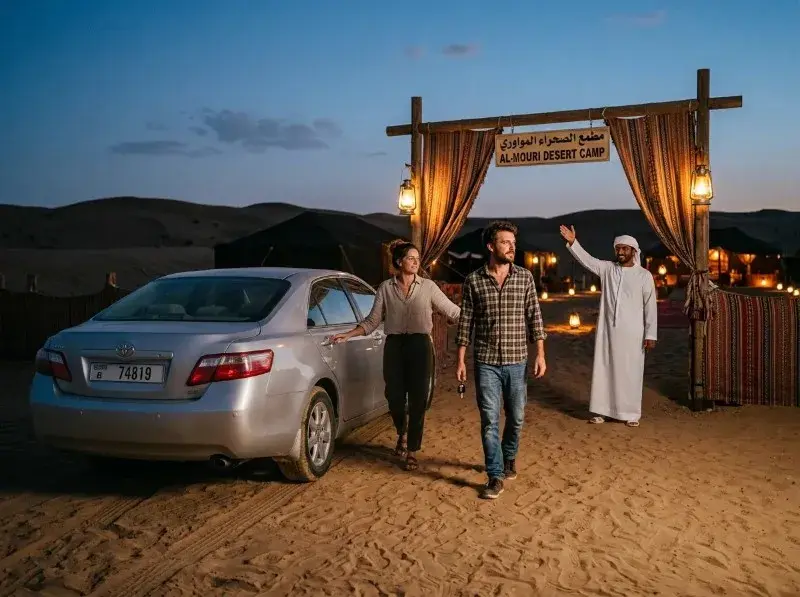
- Getting there in a 2WDYes, to the edge. The E22 is a fast dual carriageway and the graded track to our camp is fine in a saloon. What you cannot do in a normal car is leave that track. Sand starts at the roadside and it is unforgiving.
- If you have a 4×4Drop to around 14–16 PSI before you go in, travel with a second vehicle, and carry a tow rope, a shovel and a compressor. Al Khatim is beginner terrain, which is exactly why people get overconfident here.
- Finding itWe send GPS coordinates on WhatsApp the day before, with the last stretch written out in plain words. The turn-off looks like nothing and it is very easy to pass in the dark.
- Fuel and facilitiesFill up before you leave the city. There is nothing out here in the way of shops, and toilets are at the camp.
- Phone signalGenerally usable near the road and patchy once you are into the dunes. Do not rely on it as your only plan if you are driving out alone.
Rules and season
Camping, the law, and when to come
Al Khatim itself
Open desert, not a designated protected area, which is why commercial camps operate here. That is not a licence to do anything you like — see below.
Al Wathba, nearby
The Fossil Dunes have been protected since 2022 and are fenced with marked paths. No vehicles, no quads, no climbing on the formations. Some operator blogs still list it as a riding spot. It is not one.
Camping and waste
Wild camping is broadly tolerated in open desert, but federal environmental law is not a formality. No burning or burying rubbish, contained fires only, do not cut plants. Fines for individuals run from AED 2,000 into the tens of thousands.
October to March
Days of 24 to 28 degrees and cold clear nights. April and May are workable early and late. June to September you go at sunrise or after dark or you do not go. Midday any month is flat light and hard work.
If you want to sleep out here without organising any of it yourself, our overnight safari is AED 450 and the camp stays lit after the evening groups have gone.
FAQs
Al Khatim desert — your questions
Where exactly is the Al Khatim desert?
Inland from Abu Dhabi, along the E22 Abu Dhabi to Al Ain road, in the belt of dunes running east toward Al Khaznah. It is not a single point — it is a dune field, and different camps sit at different places along it.
How far is Al Khatim from Abu Dhabi?
It depends where you start. Roughly 50 to 60 km by road from Khalifa City, Al Raha, Mussafah or the airport, which is 35 to 50 minutes. From the Corniche or Saadiyat it is nearer 80 km and around an hour.
Why do different websites give different distances?
Because they measure from different places and rarely say which. Both the 45 km and the 80 km figures you will find are correct — one is from mainland Abu Dhabi, the other from the island.
Is Al Khatim a protected area?
No. It is open desert, which is why commercial camps run here. Al Wathba Fossil Dunes nearby is protected and fenced, and driving or riding there is not allowed.
Can I get there in a normal car?
To the edge and along the graded track to the camp, yes. Off that track, no — the sand starts immediately and a saloon will bury itself. Our self-drive safari is built around exactly this.
Do I need a 4×4 to visit?
Only if you intend to drive on the sand. If you are coming to a camp, a normal car reaches it. If you are dune driving, bring a proper 4×4, drop your tyres to around 14 to 16 PSI, and never go alone.
How high are the dunes?
Moderate — enough for a real dune bashing run and a proper sandboard slope, but nothing like Liwa, where Moreeb is around 300 metres. That is the point: Al Khatim is forgiving terrain.
Is the sand red like the photos from Dubai?
No. Al Khatim sand is fine and pale gold. The red dunes are at Lahbab on the Dubai side, a different geology about two hours away.
Will I see oryx or gazelle?
Almost certainly not. Those populations are largely inside fenced reserves now. You will see domestic camels, ghaf trees and, if you are out at sunrise and paying attention, lizards and desert birds.
Can I camp there myself?
Wild camping in open desert is broadly tolerated, but federal environmental law applies: contained fires only, no burning or burying waste, do not cut plants. Fines start at AED 2,000. If you want it organised for you, our overnight safari is AED 450.
When is the best time to visit?
October to March. Days around 24 to 28 degrees and genuinely cold nights. April and May work early and late. June to September, go at sunrise or after dark or not at all.
Is there phone signal?
Usable near the road, patchy in the dunes. Fine for a WhatsApp message from the camp, not something to rely on as your only plan if you are driving out alone.
Is Liwa better than Al Khatim?
As a landscape, yes, and it is not close — Liwa is the Empty Quarter. But it is 250 km and two and a half to three hours each way. For one evening, Al Khatim. For a whole day and a real love of deserts, Liwa.
What is the difference between Al Khatim and Al Khaznah?
They run into each other. Al Khaznah sits directly on the E22 further east and operators often sell the two as one area. In practice, if you have booked an Abu Dhabi safari you are somewhere in that belt.
Where is your camp?
In Al Khatim, roughly 45 minutes to an hour from the city. We send exact coordinates on WhatsApp the day before your trip.
The rest of the desert
Al Khatim is one dune field among several. The others — Sweihan, Liwa and the rest — are compared by drive time on the sand dunes page, and the Abu Dhabi desert page covers what happens at the camp once it is dark. To book the camp itself, see the evening safari.
Come and see it
Every safari on this site runs to a camp in Al Khatim, from AED 35 if you drive yourself. Send us your date and we will sort the rest.
More to read: Evening Safari · Overnight Safari · Self-drive from AED 35 · Dune Bashing