
Activity · Al Khatim desert
Camel rides in Abu Dhabi
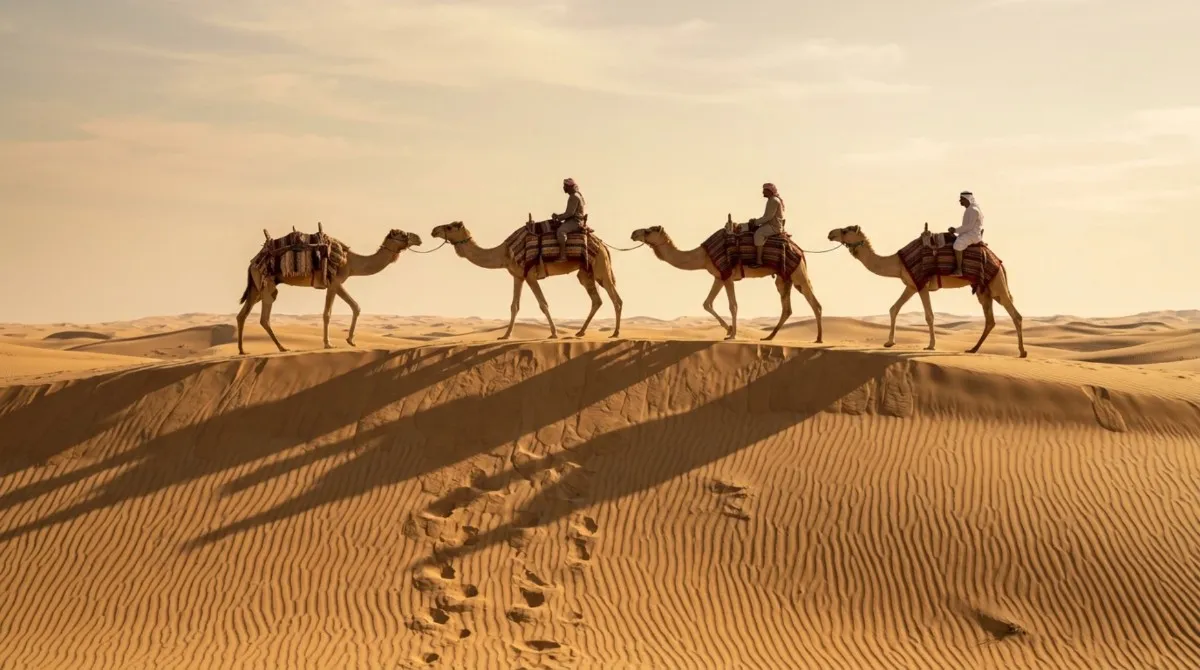
A short ride comes free with every safari. A longer one costs AED 300. And if you want to actually go somewhere on a camel rather than pose on one, there is a proper sunset trek. We tell you how many minutes each of those is, because almost nobody else does.
- Short ride free with every safari
- longer ride AED 300
- Sunset trek AED 390
- Riders from 4
- Handler leads every camel
One adult per camel. A young child can ride in front of a parent.
The question nobody answers
How long is the camel ride, really?
Every safari listing in Abu Dhabi says “camel ride included.” None of them says for how long. The honest answer across this market is a short led loop of a few minutes — enough for the photograph, not enough to feel like a ride. Here are the three things we sell, with the minutes printed.
| What it is | How long | Where it goes | Price |
|---|---|---|---|
| Short ride Included with every safari | A few minutes | A led loop beside the camp | Free |
| Long ride Add it at the camp or in advance | A long loop | Out onto the dune line behind camp | AED 300 |
| Camel Trek A tour in its own right | The main event of the trip | Across open dunes with a handler leading | AED 390 /person |
AED 300 covers up to two riders on the long ride — a parent and child on one camel, or two people on two camels going out together. Refreshments are included on the trek. Everything is paid at the camp.
If the camel is the reason you are coming
Take the trek, not the safari add-on. A few minutes on a led loop is a photograph. Twenty minutes of walking rhythm across open sand, with nothing in front of you, is a completely different thing — and it is the part people remember years later.
What it is like
The bit that surprises everyone: standing up
The camel is already sitting when you get on. You swing a leg over, hold the front of the saddle, and then it stands — back legs first. For about a second you pitch sharply forward, and then it straightens its front legs and rocks you back.
That two-second lurch is the whole of what people find frightening. Once you are up, you are a good two metres off the ground and moving at walking pace with a handler holding the rein. Getting off is the same thing in reverse.
Lean back when it stands and forward when it kneels, and it is nothing. The handler will say this to you anyway, in whatever language you are speaking.
- Nobody steersA handler leads every camel on foot. You are not given a rein and asked to figure it out.
- The pace is a walkCamels sway side to side more than a horse does. It is slow, and after a minute your body works it out on its own.
- You can stop any timeSay so and the camel kneels. No one talks you into staying on.
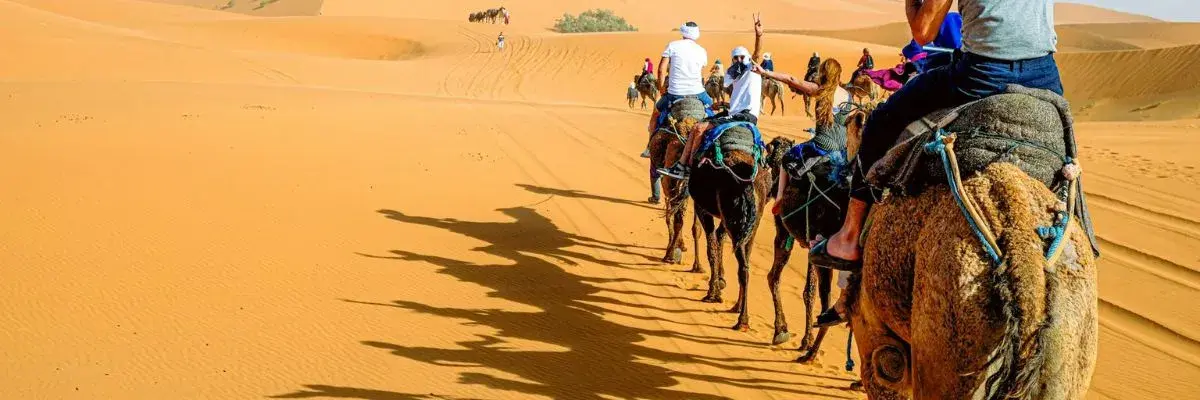
Who can ride
Our actual rules, not a vague “contact us”
These questions get asked constantly on travel forums and get answered almost nowhere. So here they are in writing.
| Situation | Can you ride? | What we suggest instead |
|---|---|---|
| Child under 4 | No | They can meet and feed the camel from the ground, which most small children prefer anyway |
| Child 4 to about 10 | Yes, seated in front of a parent | — |
| Over about 100 kg | Message us first | We will tell you honestly rather than have an awkward conversation at the camp |
| Pregnant | We advise against it | The camp, the buffet and the shows are all still yours — and skip the dune bashing too |
| Back, hip or neck trouble | Usually not | The rocking motion and the stand-up lurch are the problem, not the height |
| Nervous of animals or heights | Yes, but stand next to one first | Plenty of guests decide at that point. That is fine and it costs nothing |
One adult per camel. We do not seat two adults together — it is uncomfortable for the rider in front and it is not fair on the animal.
Welfare
Is riding a camel here alright? An honest answer
If you have read anything from animal welfare groups about camel rides, you have read about nose pegs, beatings, tied legs and untreated sores. Those reports are real. Most of them come from Egypt, Morocco and Petra rather than the Gulf, but pretending the criticism does not exist would be insulting.
Where we sit, plainly
The camels belong to the camp, not to us. We are a tour operator who brings guests to that camp — we do not own the animals and we are not going to publish welfare certificates we did not issue.
What we can tell you is what we insist on for our guests, what we see every week, and what you can check for yourself in thirty seconds when you walk up to a camel. If any of it stopped being true we would move our guests somewhere else, because it is our name on the booking.
- One adult per camelNo doubling up of grown adults. A child in front of a parent is the only shared arrangement.
- A stated weight limitAround 100 kg per rider. Ask us before you travel rather than at the camp.
- No rides in the worst heatRides run in the early morning and around sunset. Nothing goes out in the middle of a July afternoon.
- Shade and water at the tie-upThe camels rest in shade between rides, not standing in open sun waiting for the next group.
- Handlers, not casual staffThe same men look after these animals daily. It shows in how the camels behave around them.
- No sticks, no shoutingIf you ever see it on one of our trips, tell us that evening. We will act on it.
Check for yourself — it takes half a minute
Look at the camel before you get on. Calm posture and chewing is a settled animal. Clear eyes, no discharge. No rubbed-raw patches under the girth or saddle. No open sores at the nose. Feet and pads in good order. If something looks wrong to you, do not ride, and tell your guide why.
And if a camel ride anywhere is being sold to you suspiciously cheaply, that is usually a sign that the saving is coming out of the animal.
Myths
Do camels spit? Do they bite?
Spitting
Camels can spit, and what comes out is stomach contents rather than saliva, which is why it smells the way it does. It is a defensive or dominance behaviour and it is almost always rutting males. Trekking camels that work with people daily very rarely do it.
Biting
A camel that is startled or crowded can nip. The way to avoid it is the way you avoid it with any large animal: approach from the side where it can see you, do not grab its head, and let the handler tell you when to touch it.
Feeding
The handler will hand you the feed if it is a good moment. Do not offer food from your pocket — the wrong thing at the wrong time is a real problem for the animal, and camels are quick to associate people with snacks.
Washing your hands
Health authorities advise washing your hands before and after touching camels, and avoiding raw camel milk. There is hand wash at the camp. It takes ten seconds and it is worth doing.
Not all the same thing
Camel ride, camel farm, camel races or the souk?
Four quite different days out get searched with the same words. Here is which one you actually want.
- A ride in the dunesWhat this page is about. Sand, silence, a handler on foot, and a camel walking you out past the camp. Book it with a safari or as a trek.
- A camel farm visitWorking farms sit along the roads out of the city. Calves, feeding, and camels doing nothing in particular. Good with children, and often the part they talk about afterwards. Ask us and we will build a stop into a private trip.
- Al Wathba race trackAbout 45 km east of the city on the Al Ain road. Racing runs in the cooler months, early in the morning, and entry is free. It is loud, fast and completely unlike a tourist ride — camels running behind a convoy of 4x4s.
- Al Ain camel marketA real trading market rather than an attraction, out near Al Ain. Busiest in the morning. Go with someone who knows it, be polite about photographs, and understand that people are working.
The dune ride is the one you can do this evening. The others need planning, and two of them are better in winter.
When to go
Sunrise or sunset — and never the middle of the day
Camels are fine in heat. People on top of them are not, and neither is standing around in the sun waiting your turn. Rides run early or late, and in June, July and August only early or late.
- SunriseCool, quiet, and the sand still holds the night in it. The light is flat and clean rather than orange. This is the one to take if you have small children or if you hate the heat.
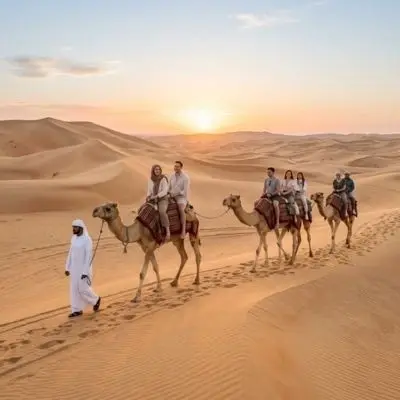
- SunsetWarmer, busier, and the light does what you came for. Long shadows off the camel across the sand. Most people choose this, and it lines up with the BBQ afterwards.
- November to MarchComfortable at almost any hour. Bring a layer for after dark — the desert drops fast once the sun is gone.
- June to SeptemberSunrise or after sunset only, and shorter sessions. We will move a booking rather than send you out into a 40-degree afternoon.
Practical
What to wear, and how to get a photograph worth keeping
Loose, covered, comfortable
Long, loose trousers — you are straddling a wide saddle, and shorts and bare legs against blanket and rope is not comfortable. Closed shoes for the sand. A scarf or hat for the sun.
Leave them with someone
You want both hands free on the saddle horn. Anything loose in a pocket will end up in the sand and stay there.
Hand the phone over
The good picture is the one someone else takes of you from the ground, low and slightly behind, with the dune line behind the camel. Taking it yourself from the saddle almost never works.
The last twenty minutes of light
Ask the handler to walk you along the ridge rather than across it. The silhouette is the shot, and it lasts about twenty minutes.
FAQs
Camel rides in Abu Dhabi — your questions
Is the camel ride included in a desert safari?
Yes — a short led ride is included with every safari on this site, at no extra cost. It is a few minutes on a loop beside the camp. If you want longer, the longer ride is AED 300 and the dedicated trek is AED 390.
How long is the camel ride?
The included one is a few minutes. The paid one is 15 minutes and goes out onto the dune line. The Camel Trek is a tour in its own right and the ride is the main part of it, not an add-on.
How much does a camel ride cost in Abu Dhabi?
Free with any of our safaris for the short ride. AED 300 for the longer ride, covering up to two riders. AED 390 per person for the Camel Trek, refreshments included. All paid at the camp.
What is the minimum age?
Four. Children from about four to ten ride seated in front of a parent. Under fours can meet and feed the camel from the ground, which most of them enjoy more anyway.
Is there a weight limit?
Around 100 kg per rider. If you are near or over that, message us before you travel and we will give you a straight answer rather than have the conversation in front of a group at the camp.
Can I ride a camel while pregnant?
We advise against it. It is not the height, it is the rocking and the lurch as the camel stands and kneels. The camp, the food and the shows are all still open to you, and we would skip the dune bashing too.
Can two people ride one camel?
A child in front of a parent, yes. Two adults, no — it is uncomfortable and it is not fair on the animal.
Do camels bite or spit?
Rarely, and almost never the ones that work with people every day. Spitting is mostly rutting males, and what comes out is stomach contents rather than saliva. Approach from the side, let the handler guide you, and it will not come up.
Do I have to steer it?
No. A handler leads every camel on foot for the whole ride. You hold the saddle and sit.
Is it scary?
The one moment people find alarming is the camel standing up — back legs first, so you pitch forward for a second. Lean back for that, and the rest is a slow walk.
Is riding camels ethical?
It is a fair question and we have written a proper answer on this page rather than a line of reassurance. Short version: the camels belong to the camp, not to us; we insist on one adult per camel, a weight limit, no rides in peak heat, shade and water between rides, and no sticks. And we tell you what to look at yourself before you get on.
Can I feed the camel?
Ask the handler and he will hand you the feed if it is a good moment. Do not offer anything from your own pocket.
Do I need to wash my hands afterwards?
Yes, and before too. Health authorities advise it around camels, and there is hand wash at the camp.
Can I do a camel ride without the dune bashing?
Yes. Plenty of guests skip the drive — usually pregnant guests, older guests, or anyone with back trouble — and still do the camel, the camp, the food and the shows. Tell us when you book and we will arrange the transfer accordingly.
Sunrise or sunset?
Sunrise for cool air, quiet and small children. Sunset for the light and the BBQ afterwards. Most guests take sunset.
Where do the rides happen?
At our camp in the Al Khatim desert, out along the Abu Dhabi–Al Ain road, roughly 45 minutes to an hour from the city depending on where you are picked up.
Can I visit a camel farm instead?
Yes — there are working farms on the way out to the desert. It is not a standard stop, so ask us and we will build it into a private trip.
Do I pay in advance?
No. Nothing is charged on this website. Cash or card at the camp, VAT included, free cancellation up to 24 hours before pickup.
The best months for a camel ride
Cool sand and mild air make the ride far more pleasant, which puts November through March well ahead. In high summer the short ride is still included but nobody lingers. See the best time to go page. Every activity at the camp, and what each one costs, is set out on the desert activities page.
Want the long ride or the trek?
Send us your date and group size. We will confirm the camels, the pickup time and the total — and if the trek is not the right call for your group, we will say so.
More to read: Evening Safari · Morning Safari · Quad Biking · All prices