
Heritage Village: Twenty Free Minutes of Pre-Oil Abu Dhabi
A recreated oasis settlement with the city’s best skyline view attached. Modest, free, and honest about what it is — which is more than most attractions manage.
- Entry free
- 20–40 minutes
- Skyline viewpoint
Sixty years ago Abu Dhabi was palm-frond houses, pearling boats and wells — and the city knows how fast that story is receding, which is why this small reconstruction exists on the breakwater opposite the skyline that replaced it.
We will be straight with you, as our city tour page already is: this is a twenty-minute stop, honestly optional. But it is a free twenty minutes, and the juxtaposition it offers — the old life in the foreground, the towers across the water — is the single quickest history lesson in the Emirates.
A reconstruction, and honest about it
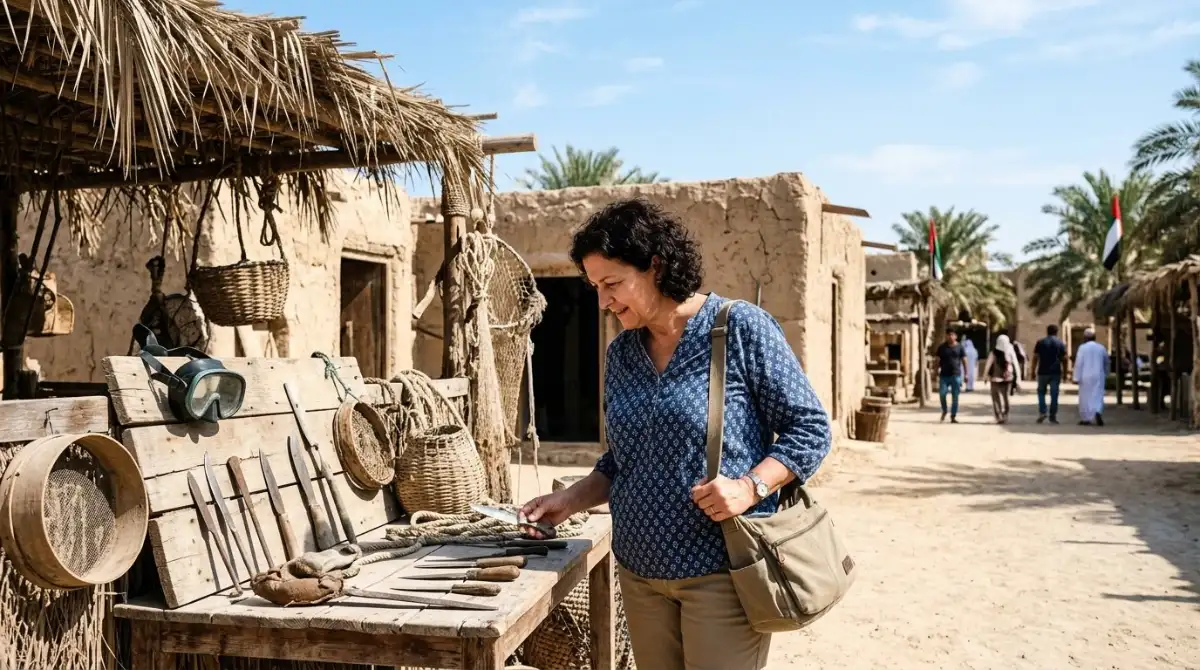
The Heritage Village is a recreated pre-oil settlement on the breakwater near Marina Mall: barasti houses of palm frond, a mud-brick souq, a small mosque, a well and falaj irrigation demonstration, and workshop rooms where craftspeople sometimes work.
It does not pretend to be an original site, and that honesty wears well. Think of it as a life-size illustration: this is how people built, stored water, cooked and traded on this coast within living memory.
Entry is free, which sets the contract exactly right. Nobody leaves feeling short-changed by a free museum with a view.
Pearls, tools and the occasional craftsman
The exhibit rooms hold the coast’s old economy: pearling weights and nose clips, fishing gear, falconry equipment, coffee pots and daggers — the working kit of the Gulf before oil, plainly labelled.
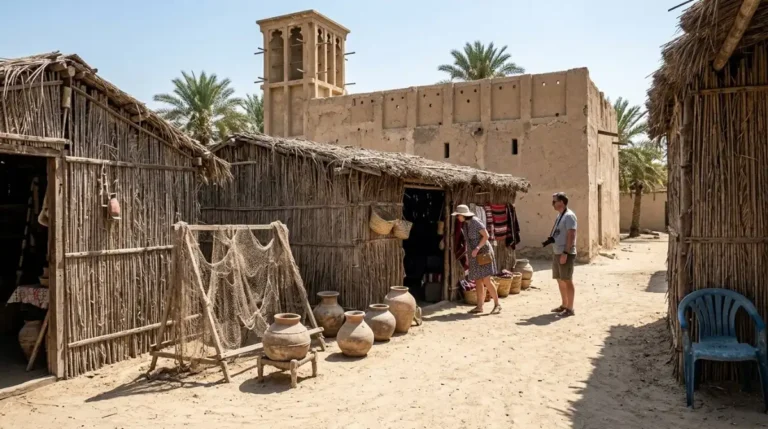
When the workshops are active — metalwork, pottery, weaving, glass — the village is at its best; when they are quiet, the courtyard and souq still carry the idea.
If the old objects catch you, note that the coffee ritual and falconry you meet here are the same ones running live at our desert camp every evening — the falconry page and majlis page pick up the thread.
The best free skyline in the city
Walk to the water’s edge and turn around: the full Corniche skyline stands across the strait, close enough to fill a frame, far enough to fit in one. This is where the classic Abu Dhabi photograph is taken.
Late afternoon is the slot — mud brick goes gold, towers start to light, and the two Abu Dhabis, sixty years apart, sit in the same photograph.
The village keeps ordinary daytime hours that can shift with season and holidays; being free, the sensible plan is to fold it into a Corniche-end afternoon rather than make a special trip.
The full-strength version is in Al Ain
If twenty minutes here leaves you wanting the real thing, it exists — ninety minutes inland. Al Ain’s oases, forts and old souq are the originals: UNESCO-listed, working, and unstaged. Our Al Ain day trip page covers it.
And the desert itself is the oldest exhibit of all. The Abu Dhabi desert page and the camp evening — coffee from the dallah, dates, the fire — are the living continuation of everything in these display cases.
That is the honest hierarchy: Heritage Village for the introduction, Al Ain for the history, the desert for the experience.
On the tour, or a free half-hour
The village sits at the western end of the Corniche near Marina Mall, ten minutes from Emirates Palace — which is why both our tours thread it into that end of the city: the half-day at AED 499 gives it its twenty minutes between the palace and the Corniche.
On your own, pair it with the breakwater viewpoint and a Corniche walk and you have a free, excellent late afternoon.
Then let the theme finish itself properly: the evening safari from AED 35 is the same heritage, alive — and it serves dinner.
Heritage Village — your questions
Is Heritage Village free?
Yes – entry is free, which sets the expectation correctly: this is a modest, well-meant recreation, not a major museum. At free, twenty to forty minutes here is a perfectly good trade.
What is there to see?
A recreated oasis settlement – barasti palm-frond houses, a mud-brick souq, a small mosque, workshops where craftspeople sometimes work metal, pottery and weaving – plus one of the best skyline views in the city, straight across the water.
How long do you need?
Twenty minutes covers it politely, forty if the workshops are active and you linger at the viewpoint. It is a stop, not a destination – and we say the same on our city tour page.
Is it authentic?
It is a reconstruction, built to show what pre-oil life looked like – and it is honest about that. For the real thing at scale, Al Ain’s oases and forts are the serious version; this is the convenient introduction.
When should you go?
Late afternoon: the light softens the mud brick, the skyline across the water starts to glow, and the heat backs off. Check opening days locally as hours can shift – it is free, so a wasted trip costs only time.
Is it on your city tour?
Yes – both tours pass this western end; the half-day at AED 499 includes it alongside Emirates Palace and the Corniche. Twenty minutes, the viewpoint, and onward.
Read next
It shares an afternoon naturally with the Corniche on the city tour. The full-strength history is the Al Ain day trip, and the living version is the evening desert safari — coffee, falcons and fire included.
The museum takes twenty minutes — the real thing takes an evening
City tour from AED 499 the car with the village folded in, and the desert camp — where the coffee pot still pours — from AED 35 a head. Nothing paid in advance.