

If you remember the headlines from late February, you may still be carrying the question around: is Abu Dhabi safe to visit? The short answer in August 2026 is yes — but you should not have to take our word for it, so this page gives you the dated facts and lets you decide.
One thing to watch as you read anything on this subject: check the date. A great deal of what is still online about UAE safety was written in March and has never been revised.
What Happened, and How It Ended
On February 28, 2026, the United States and Israel launched coordinated airstrikes on Iran, which resulted in the death of Iran’s Supreme Leader. Iran responded with retaliatory drone and missile attacks targeting several Gulf countries, including the UAE.
That triggered real disruption — airports closed, airspace shut, and thousands of visitors stranded overnight. It was serious, and we are not going to pretend otherwise.
It also ended. A ceasefire brokered by Pakistan halted the fighting in the spring. On 3 May 2026 the UAE’s General Civil Aviation Authority lifted every air traffic restriction it had put in place since the conflict began, saying UAE airspace had returned to “normal status”. Flights have run normally since.
What the Advisories Say Today — and Their Dates
Advisories move slowly, and a government would always rather leave a warning up too long than lift it too early. That is sensible of them, but it means the date matters as much as the wording. Here is where the four most-read advisories stood when this page was last checked, on 28 August 2026:
🇦🇺 Australia (Smartraveller)
Back to “exercise a high degree of caution” — the level Australia has applied to the UAE for years on general terrorism grounds, and the same level it applies to a great many ordinary destinations. The March “do not travel” warning is gone.
🇺🇸 United States (US State Department)
Still Level 3, Reconsider Travel — but look at the date on it: 3 March 2026. It was written five days into the conflict and has not been revised since the ceasefire or since the UAE reopened its airspace in May. It is the most alarming advisory of the four and also the most out of date.
🇬🇧 United Kingdom (FCDO)
No advice against travel. The FCDO updated its UAE page on 24 July 2026. It notes that the wider region remains unpredictable and that airspace closures and flight disruption are possible, and asks travellers to keep plans under review — but it does not tell British nationals to stay away.
🇨🇦 Canada
Canada keeps a regional caution in place for the Gulf. Check the current wording yourself before you travel; the link is further down this page.
Bottom line: two of the four have already stepped back, one is a routine long-standing caution, and the harshest one has not been touched since 3 March. That is a very different picture from the one this page described in the spring.
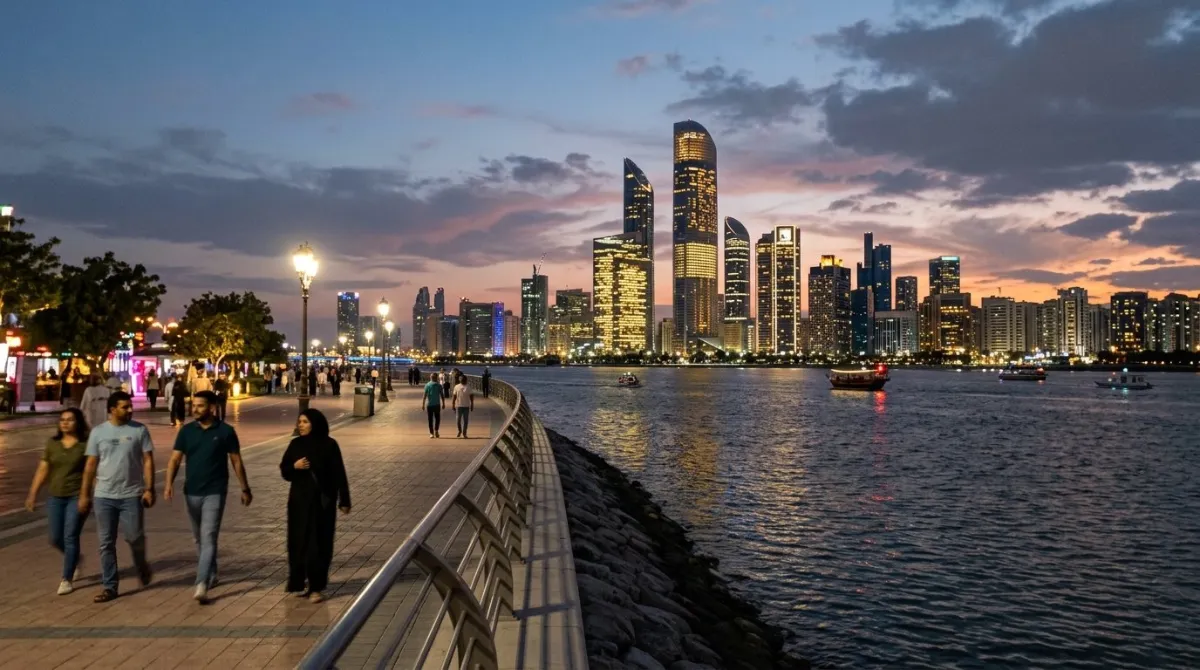
What It Is Actually Like on the Ground
Advisories describe risk. They do not describe a street. Here is the street.
Here’s what we know:
- Abu Dhabi’s air defense systems responded effectively during the initial strikes
- The UAE government stepped in to cover hotel costs for over 20,000 stranded tourists—that’s a government taking care of visitors even in crisis
- Abu Dhabi airport reopened in phases from early March and has been running without restrictions since 3 May
- Desert areas and safari camps, well away from urban infrastructure, were barely affected even at the peak
- Crime against tourists remains extremely rare. Abu Dhabi consistently scores near the top globally for tourist safety in normal conditions
Today the city is simply operating. Shops, hotels, malls, the Corniche, the mosque, the museums — all open on ordinary hours. Airlines have been rebuilding schedules through the summer for the winter season.
So Should You Visit?
For most people, yes. The honest split now looks like this.
Worth pausing over if:
- Your own government has a live “do not travel” warning — check the date on it first
- Your flights are not yet confirmed, or you are routing through airspace still affected elsewhere in the region
- You have no travel insurance — ordinary advice for any trip, not a comment on the UAE
- Your own comfort level is simply not there yet, which is a perfectly good reason on its own
Go ahead if:
- You are already in Abu Dhabi — the city is running normally
- You are booking for the winter season, which is when the desert is at its best anyway
- Your bookings are flexible and nothing is charged in advance
- You want a straightforward answer rather than a headline: flights are normal, the city is open, the camps are running
UAE Travel Advisory 2026—What to Watch
Do not rely on this page, or any tour operator’s page, as your only source. Read the originals, and note the date at the top of each:
- US State Department: travel.state.gov
- UK FCDO: gov.uk/foreign-travel-advice/united-arab-emirates
- Australia Smartraveller: smartraveller.gov.au
- Canada: travel.gc.ca
Most of them let you subscribe to email alerts, which is a better habit than checking a travel blog.
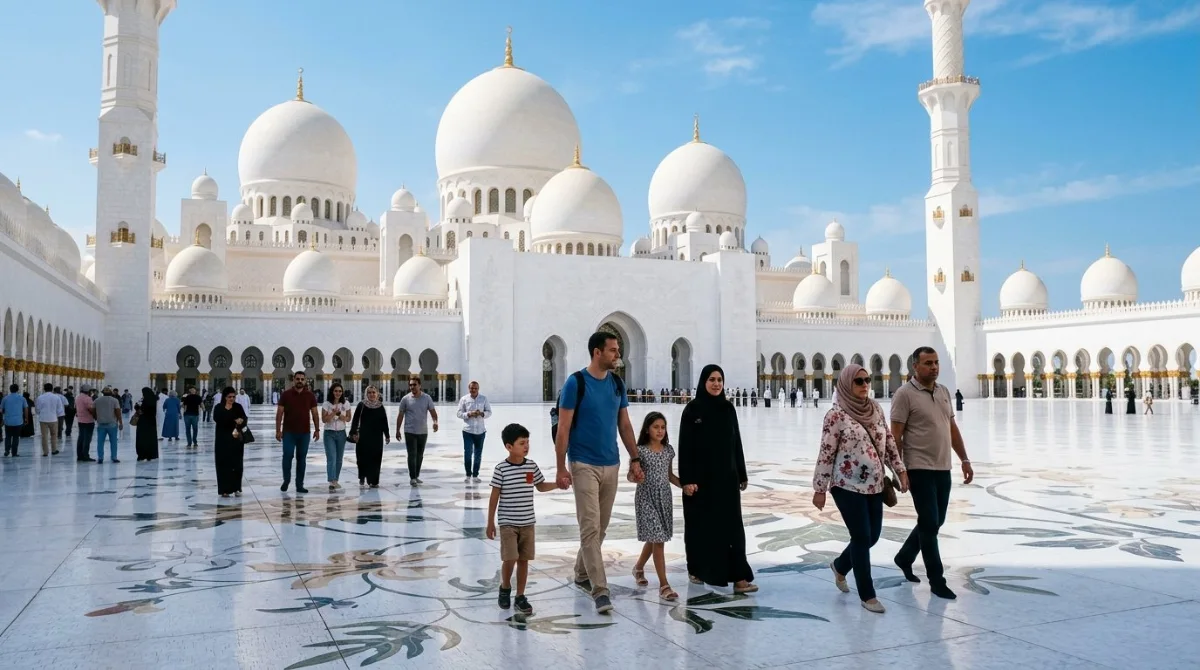
What About Desert Safari in Abu Dhabi?
Running normally, every night, and it has been since the spring.
Even at the worst of it, the desert camps were the least affected part of the whole tourism picture. They sit an hour inland, well away from airports, government buildings and energy infrastructure — the locations advisories actually name. That is why they kept running when much of the city-based tourism had paused.
Morning, evening and overnight safaris all run to their normal timings, with hotel pickups across the city and the coach from Al Wahda, Mazyad and Safeer malls.
Every booking is free to cancel up to 24 hours before pickup and nothing is charged in advance, so if your plans do change it costs you nothing.
Practical Tips If You’re Traveling to Abu Dhabi in 2026
None of this is conflict advice. It is ordinary sensible travel practice for the UAE:
- Buy travel insurance and read what it actually covers
- Choose operators with free cancellation and pay on arrival rather than upfront
- Register with your embassy as soon as you arrive so they can contact you in an emergency
- Give diplomatic, military and energy sites a wide berth — standard advice across the region
- Download the UAE National Emergency app and sign up for alerts
- Save emergency numbers: Police 999 | Ambulance 998 | Fire 997
- Keep your passport and travel documents on you at all times
The Bigger Picture
Abu Dhabi has spent decades building its reputation as the Middle East’s most stable, welcoming, and tourist-friendly destination. Tourism is a massive part of the UAE’s non-oil economy, and the government has strong reasons—financial and diplomatic—to restore normalcy as quickly as possible.
The swift move to cover stranded tourists’ accommodation costs was not just a kind gesture. It was a signal: Abu Dhabi values its visitors and will go out of its way to protect that relationship.
Regional conflicts have touched the Gulf before. And each time, Abu Dhabi has come back stronger.

The Short Version
In August 2026, Abu Dhabi is open and operating normally. Airspace restrictions were lifted on 3 May. The UK dropped its travel warning on 24 July. Australia is back to its long-standing routine caution. The US advisory still reads Level 3, and it still carries the date 3 March.
Read the originals, check the dates, and make your own call. If you are coming, the dunes, the hospitality and the skyline at sunset are exactly where you left them.
Read next
Once safety is settled, the rest is logistics. The first-timer’s guide walks through the evening minute by minute, the before-you-book hub answers the small practical questions, and the prices and timings page lists every package with its price.
Last checked 28 August 2026 against the US State Department advisory (dated 3 March 2026), the UK FCDO page (updated 24 July 2026), Australia’s Smartraveller, and the UAE General Civil Aviation Authority announcement of 3 May 2026.
Bookings on WhatsApp: +971 50 277 1900
Message us on WhatsApp