
A Sensory-Friendly Desert Safari: Planning Around Noise, Crowds and Surprise
The desert itself is one of the quietest places your family will ever stand. The camp has one loud hour. Knowing exactly which parts are which — and that the loud parts are optional — is what makes this trip plannable.
- 6 min read
- The loud parts are optional
- Timeline known in advance
We are not specialists and this page will not pretend to be one — you know your child or your companion, and we do not. What we can do is something more useful than reassurance: map the entire evening honestly, sound by sound, so you can judge for yourselves. And make one structural point up front: almost every intense part of this trip is optional, and the quiet parts are the ones nothing can take away.
The sensory map, hour by hour
| Part of the evening | What it is like | Optional? |
|---|---|---|
| The highway drive, ~1 hr | Ordinary car journey, air conditioned, predictable | The trip needs it |
| The tyre stop | A few minutes out of the car; hissing air as tyres deflate | Stay in the car if easier |
| Dune bashing, 30–45 min | Engine noise, unpredictable movement, cheering — the most intense block of the evening | Fully — gentle route or straight to camp, free |
| Sunset stop | Open, quiet, unhurried | Yes |
| Camp arrival & the lull, ~90 min | Calm. Background music, spread-out people, camels, sand to dig in | The best part for many families |
| The shows, ~1 hr | Amplified music, a spinning lit costume, then a fire act — the loudest hour | Sit far back, or step out to the sand |
| Dinner | Buffet, come-and-go, no fixed sitting | Eat when it suits |
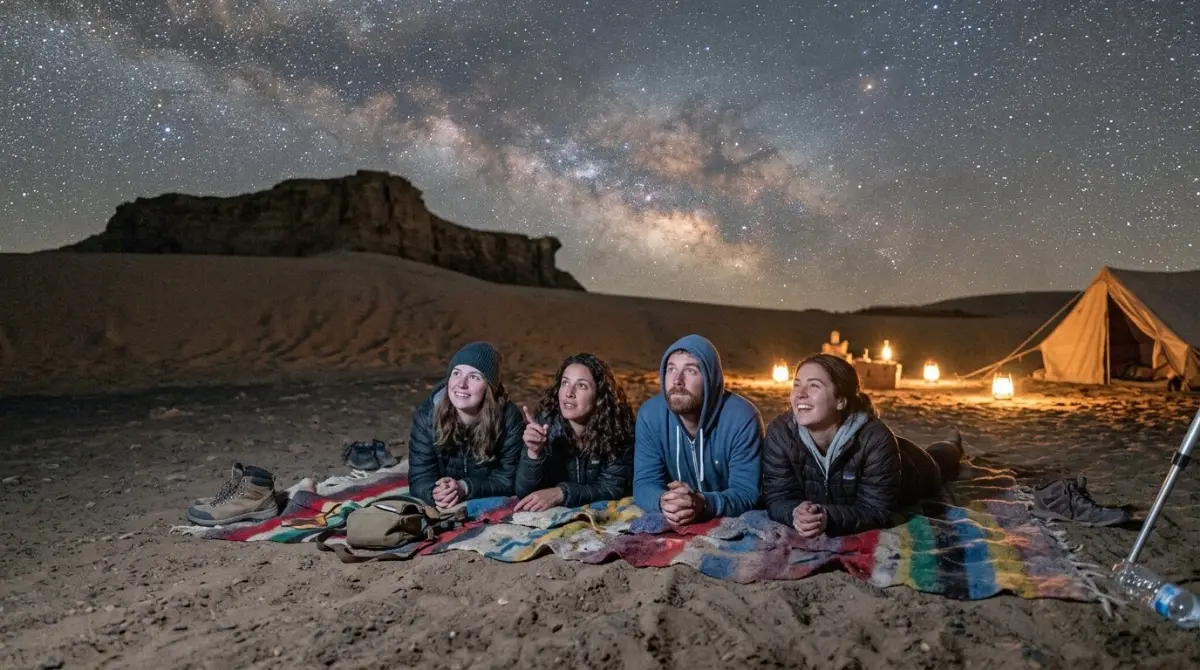
| After dark | Star-filled, near-silent desert a short walk from the seats | The reward |
Two honest flags in that table: the dune drive and the show hour. Everything else is calmer than a shopping mall — and both flags have exits built in.
Shaping the trip around it
Skip or soften the dune drive. Tell the driver and he takes the graded track straight to camp, or the gentle low route — free, routine, and decided by you, not negotiated. The same options exist for motion sickness and they work identically here.
Take a private car. This is the single biggest lever: your own vehicle means no strangers, your own volume, stops when you need them, and a familiar retreat parked at the camp all evening — a door that closes, which is sometimes the whole game. AED 599 for up to seven.
Tell us and we seat you away from the stage. We reserve seating when asked; the far edge of the carpets takes the show from loud to background, and the sand behind the seating is open if someone needs to walk during it.
Aim for a quieter evening. Weeknights outside the November–February weekend peak are visibly emptier. Say the word and we will steer you to the quietest date near yours.
The quiet version of the evening
If the show hour is simply not worth the risk, build the evening without it. The morning safari is the ready-made quiet trip: out early on cool, empty sand, no shows, no crowd, done by midday — predictable from end to end.
Or keep the evening but treat the shows as the moment for your own plan: dinner is a buffet with no fixed sitting, so many families eat early and spend the show hour on the dark sand behind the camp, where the noise drops away in metres and the sky is doing something better anyway. Nobody minds and nobody asks.
Food, texture and predictability
Buffets are kind to particular eaters: nothing arrives unannounced on a plate, and you assemble exactly what works. The reliable plain options are rice, fresh bread, grilled chicken, pasta and potatoes, with fruit after — the full menu page lists every station. Water and soft drinks are unlimited, and bringing a familiar snack from the hotel for a particular eater is completely fine.
One texture note that catches some children wonderfully and others not at all: the sand itself — fine, soft and everywhere. For most kids it is the toy; if it is likely to be the problem, closed shoes and a spot on the carpets rather than the open sand keep it at arm’s length.
What to tell us
Whatever you are comfortable sharing — a diagnosis is not needed and not asked for. What helps is practical: loud noise is hard, needs to know the schedule, may need to leave the show, particular about food. Each of those maps to something concrete on our side: seating position, the exact timeline in advance on WhatsApp, the private car, the buffet walk-through.
The full hour-by-hour timeline already exists on the first-timer’s guide, which many families use as the social story for the trip: read it together, and nothing on the evening arrives as a surprise.
Questions from families planning around sensory needs
Is a desert safari suitable for an autistic child?
It can be, planned honestly. The evening has two intense blocks — the dune drive and the show hour — and both are optional: the drive can be skipped entirely and the shows watched from the far edge or from the quiet sand behind the camp. The rest of the evening is calmer than a shopping mall, and the desert after dark is genuinely silent.
Which parts of the safari are loud?
The dune drive (engine and unpredictable movement, 30–45 minutes) and the show hour at the camp (amplified music, then a fire act). Everything else — the highway drive, the sunset stop, the ninety-minute lull, dinner and the dark desert after — runs quiet.
Can we skip the shows or leave during them?
Yes, freely. Dinner is a buffet with no fixed sitting, so many families eat early and spend the show hour on the dark sand behind the seating, where the noise falls away within metres. Nobody minds and nobody asks questions.
Is there a quieter version of the trip?
The morning safari: out early on cool, empty sand, no shows, no crowd, finished by midday, predictable end to end. For the evening trip, a private car plus seating away from the stage gets most of the way there.
Can we see the schedule in advance?
Yes — the first-timer’s guide on this site walks the whole evening hour by hour, and many families read it together beforehand so nothing arrives as a surprise. Message us and we will also confirm your exact pickup and timings in writing.
Do you need to know a diagnosis?
No, and we do not ask. What helps is practical: loud noise is hard, needs the schedule, may need to leave the show, particular about food. Each maps to something concrete — seating position, the timeline in advance, the private car, or a walk through the buffet.
Read next
The first-timer’s guide is the hour-by-hour timeline families use to preview the evening together. The skip-the-dunes mechanics are on the motion sickness page, ages and the car seat rule on travelling with little ones, and every station of the buffet on the food menu. Every kind of guest is gathered on who it’s for.
Tell us what helps and we will build the evening around it
Seating away from the stage, the exact timeline in writing, a private car with a door that closes, the quietest date near yours. No diagnosis needed, no extra cost for the planning, and nothing paid until you are there.