
Desert Safari and Motion Sickness: How to Do It Anyway
Two settings exist that almost nobody tells you about: you can ask for the gentle route, and you can skip the dune drive entirely and still get the whole evening. Neither costs anything.
- 7 min read
- Dune drive 30–45 min
- Skippable on request
People who are perfectly fine in cars, on boats and on planes sometimes struggle with a dune drive. That surprises them, and it surprises the person who booked the trip for them. It is worth understanding why before you decide the whole evening is not for you.
The short version: the dune section is thirty to forty-five minutes of a four-hour evening, it can be dialled down to almost nothing, and it can be dropped altogether without changing anything else you have paid for. Nobody at the camp will know or care.
Why a dune drive is different from a car journey
Ordinary travel sickness comes from a mismatch: your inner ear reports movement your eyes do not confirm. A dune drive makes that mismatch about as bad as it gets, for four reasons stacked on top of each other.
The movement is unpredictable. On a road you anticipate the next bend from the road itself. On sand there is no road, and the car pitches, rolls and drops in a pattern you cannot read from the back seat.
There is often no horizon. Between dunes you are looking at a wall of sand ten feet from the window. The one visual reference that settles your inner ear is exactly what is missing.
You are usually warm and have just eaten. Most people do this in the late afternoon after a hotel lunch, which is the worst possible preparation.
It is longer than people expect. Thirty to forty-five minutes across the ridges on a standard package. That is a long time to be fighting it if you have not prepared.
None of this makes it dangerous. It makes it manageable, which is a different thing, and the rest of this page is how.
Eight things that actually help
1. Eat something light about an hour before. Not a full meal and not an empty stomach — both make it worse. Plain carbohydrates are the safe choice.
2. Take the front seat. Ask when you are collected rather than at the tyre stop. Nobody minds and there is always one going spare somewhere in the convoy.
3. Look at the horizon, or as much of it as you can see. When there is no horizon, look at the crest of the dune ahead rather than the sand beside you.
4. Sit forward, not slumped back. Head against the headrest, eyes up. Slouching lets your head move independently, which is the thing to avoid.
5. Put your phone away. Reading or filming during the dune section is the fastest route to feeling awful. Film the sunset stop instead; it is the better shot anyway.
6. Open the vent, or ask for the window. Cool moving air on your face helps more than it has any right to.
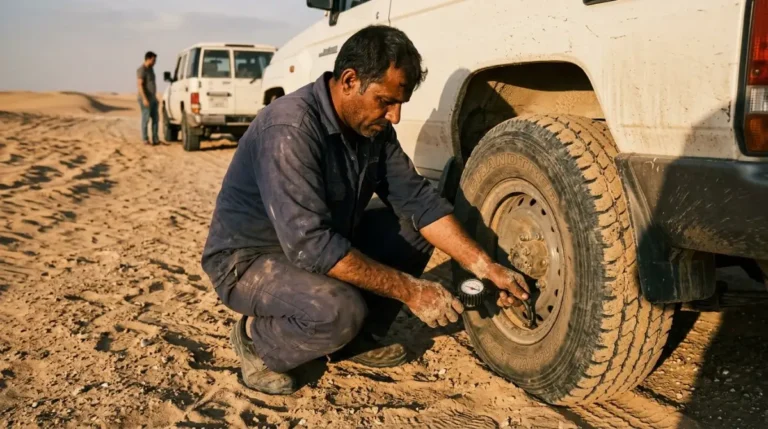
7. Say something before the drive starts, not during. The tyre stop is the moment. The driver deflates the tyres from about 35 psi to 15 there, everyone gets out, and that is when to say you would rather take it easy.
8. Have water, and sip it. Unlimited water is included at the camp, but carry a bottle in the car for the dune section.
Where to sit
| Seat | How it feels | Worth asking for? |
|---|---|---|
| Front passenger | Best view, most warning of what is coming, least head movement | Yes — ask first |
| Middle row, window | Good. You can see out and forward between the front seats | Second choice |
| Middle row, centre | Fine for most people. Poor forward view | Neutral |
| Rear row | Furthest from the pivot point, most vertical movement, worst view | Avoid if you are prone to it |
If you are on a private car this is not a negotiation — the vehicle is yours and you sit where you like. On a shared 4×4 the front seat usually goes to whoever asks, so ask at the hotel rather than in the desert.
The two settings nobody mentions
Gentle. Say the word to your driver and the drive changes completely. He takes the low route between the dunes rather than over the crests, drops the speed and cuts out the drops that make your stomach lift. You still get the desert, the sand, the crossing — just without the roller-coaster. It costs nothing and it is not a favour.
Skip it. Less well known: the dune drive can be left out entirely. The driver takes the graded track and goes straight to camp. You lose thirty to forty-five minutes of driving and you lose nothing else — the camel ride, the sandboarding, the shows, the BBQ, the stars are all still yours, at the same price. Say so when you book so the timing works, and again to the driver on the day.
If one person in a group is struggling and the others want the full drive, the honest answer is a private car, where the whole vehicle takes the pace you choose. On a shared 4×4 the driver will always take the gentler line if anyone in the car asks for it, which sometimes disappoints the rest of the group.
Medication and timing
Travel sickness tablets work, and the timing matters more than the brand. The usual advice is to take one thirty to forty-five minutes before pickup — not when you reach the dunes, by which point it is too late to be much help. Pharmacies in Abu Dhabi carry the standard options and can advise you properly; we cannot, and would not try to.
Two things worth knowing. Most of these tablets make you drowsy, which is a fair trade on an evening trip and a poor one on a sunrise safari when the whole point is the light. And if you are already on medication, ask a pharmacist rather than guessing.
Ginger sweets and acupressure bands have their believers. The evidence for them is thin, they cost almost nothing and they do no harm — so if they work for you, use them. Just do not rely on them instead of the seat, the horizon and the gentle request, which are the things that reliably help.
If it happens anyway
Tell the driver. That is the whole answer. He will stop, and stopping on a dune for a few minutes is completely routine — it happens on plenty of evenings and nobody in the car will think anything of it.
Get out, stand on the sand, look at something far away and breathe. Cool air and a fixed horizon fix most of it within five minutes. Then either carry on gently or ask to go straight to camp; both are fine and neither changes what you pay.
Once you are at the camp it passes quickly. There is ninety minutes of sitting before dinner is served, which is more recovery time than most people need, and the food is worth waiting for by then.
Who should skip the dune drive entirely
Motion sickness is an inconvenience. These are different, and for these the answer is not a gentler drive but no dune drive at all:
Anyone who is pregnant. Anyone with a heart condition, a back or neck problem, or recent surgery. And children under three, for whom there is no seat that makes the dune drive appropriate.
None of that rules out the evening. The graded route to camp is a normal drive on firm ground, and the camp itself is flat. Tell us when you book and we will arrange the trip around it rather than hoping it works out on the night. The dune bashing page sets out what the drive involves and how the vehicles are set up.
Motion sickness questions
Can I do a desert safari if I get motion sickness?
Almost certainly yes. The dune drive is thirty to forty-five minutes of a four-hour evening, and you can ask for a gentle route or skip the dunes altogether at no extra cost. Everything else at the camp is unaffected.
Can I skip the dune bashing on a desert safari?
Yes. Tell us when you book and tell your driver on the day, and he will take the graded track straight to the camp. The price does not change and you keep the camel ride, sandboarding, shows and dinner.
Which seat is best if I get car sick?
The front passenger seat, by a clear margin — best forward view and the least head movement. The rear row is the worst. Ask for the front seat when you are collected rather than at the tyre stop.
When should I take a travel sickness tablet before a desert safari?
About thirty to forty-five minutes before your pickup, not when you arrive at the dunes. Ask a pharmacist which one suits you, especially if you take other medication. Most of them cause drowsiness.
Is dune bashing rough the whole time?
No, and it is adjustable. Say you want it gentle and the driver takes the low line between the dunes instead of over the crests. The intensity is set by whoever in the car asks for the least of it.
What if I feel sick during the drive?
Tell the driver and he will stop. It is routine. A few minutes out of the car with cool air and a distant horizon sorts out most people, and you can then continue gently or go straight to the camp.
Read next
The dune bashing page explains what the drive actually involves and how the cars are built for it. If you are travelling with small children or older parents, the family safari page covers what works and what does not. A private car is the answer when one person wants it gentle and the rest do not. First trip? The first-timer’s guide walks the evening hour by hour.
Say the word and the drive changes — at no extra cost
Message us before you book and we will note it on your booking, brief the driver and set the timing around it. Gentle route or no dunes at all, the price is the same either way.