The UAE Desert: One Country’s Thin Green Edge on a Sea of Sand
Beyond the towers, the UAE is mostly desert — and its share includes the edge of the largest sand desert on earth. What the landscape actually is, where its heart lies, and how a visitor touches it.
- Rub al Khali edge
- Season Oct–Apr
- From AED 35 to visit
Seen from a plane window, the truth of the UAE is plain: two strips of green and glass along the coasts, and behind them sand — ordered, enormous, reaching south until it becomes Saudi Arabia and Oman.
That sand is not backdrop. It is the country’s original landscape and its original story, and it remains astonishingly easy to reach. This page is the desert itself; the trips into it hang off every paragraph.
Sand, gravel, mountains, and a green fringe
The UAE occupies the south-eastern corner of the Arabian Desert. Inland from the Gulf coast the land runs through gravel plains into deep dune country, rising to the Hajar mountains only in the far east; the farms and cities live on a narrow irrigated fringe.
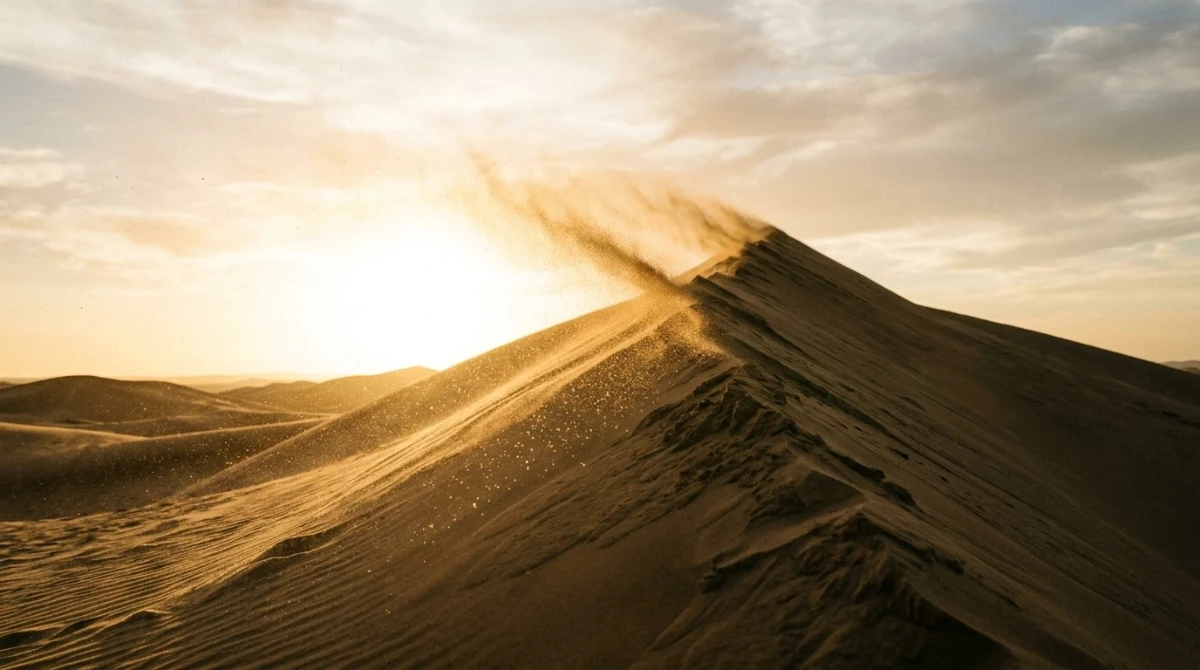
The dunes themselves change character as you go south: modest and travel-worn near the roads, then taller, redder and quieter, until the ranges around Liwa stand hundreds of metres over the sabkha flats.
Our own patch of it, Al Khatim, sits an hour east of Abu Dhabi city — the working answer to the question this page keeps circling: where do I actually stand in it?
The Empty Quarter begins in Abu Dhabi
The desert’s heart has a name older than the country: the Rub al Khali, the Empty Quarter — the largest sand desert on earth, shared by four nations, with Abu Dhabi emirate holding the UAE’s share.
Its edge is the Liwa crescent: a hundred-kilometre arc of villages and date farms where settled life has faced the great sand for centuries, with Tel Moreeb — among the tallest drivable dunes anywhere — as its landmark. The full story is on the Liwa page.
Explorers crossed it on camels within living memory; today it is 2.5–3 hours from the capital on sealed tarmac, which may be the quietest miracle in the Emirates.
Oryx, gazelle, and residents you will not meet
The desert reads as empty and is not. Its flagship is the Arabian oryx — hunted to extinction in the wild and reintroduced, now the UAE’s conservation signature. Gazelle, desert foxes, hares, monitor lizards and a long bird list share the range.
Most of it moves at dawn and dusk and hides from the heat — and from you. Tracks in the morning sand are the usual sighting, and honestly the right one.
The ghaf tree — the national tree, tapping water far beneath the sand — and the planted camel farms along the desert roads carry the living-with-the-desert story the camps retell each evening over coffee.
A winter country wearing a summer disguise
The desert’s year has two acts. October to April is the season the postcards mean: warm days, gold light, nights that turn genuinely cold under clear sky — the month-by-month hub takes it in detail.
June to September is the other desert: forty-plus by day, visited at dawn or after sunset or not at all. Our summer page is blunt because the sand does not negotiate.
Rain comes rarely and briefly, and transforms the air when it does — the rain page explains why regulars secretly hope for it.
From an evening to an expedition
The whole ladder of contact, in one paragraph: an evening safari from AED 35–100 puts you on the dunes at sunset with dinner at a camp; the overnight at AED 450 adds the night sky and dawn; Liwa is the full pilgrimage for those the sand gets hold of.
Every version starts the same way — one message with your dates — and none of it is paid in advance. The desert has waited some millions of years; it will hold your booking too.
The UAE desert — your questions
What desert is in the UAE?
The southern reach of the Arabian Desert. Its most famous part is the Rub al Khali – the Empty Quarter – the largest sand desert on earth, which fills most of Abu Dhabi emirate’s interior and spills into Saudi Arabia and Oman.
Is the whole UAE desert?
Most of it, by area – sand and gravel plains with mountains in the east and a green irrigated fringe along the coasts and oases. The cities are a narrow, spectacular exception to the country’s actual landscape.
Which emirate has the best desert?
Abu Dhabi, by geography: it holds the UAE’s share of the Empty Quarter, including Liwa and Tel Moreeb. Dubai’s desert is good and closer to its hotels; Abu Dhabi’s is bigger, emptier and runs to the horizon of the continent.
What animals live in the UAE desert?
Arabian oryx – saved from extinction and reintroduced – gazelle, desert foxes, hares, reptiles and a surprising bird list. Most are seen at dawn, dusk or never; the desert hides its residents well.
When is the UAE desert comfortable?
October to April is the season: warm days, cool – sometimes cold – nights. June to September is fierce, and the desert is visited at dawn or after sunset, if at all.
What is the easiest way for a visitor to experience it?
An evening safari from the city – an hour’s drive, dunes at sunset, a camp dinner. From AED 35 with us, and the whole ladder is on prices and timings.
Read next
Deeper into the sand: the Abu Dhabi desert, Al Khatim, Liwa and the dunes themselves. To stand in it this week: prices and timings.
The oldest landscape in the country, one hour away
Tell us your dates and how deep you want to go — an evening, a night, or the road to Liwa. From AED 35, nothing paid in advance.