
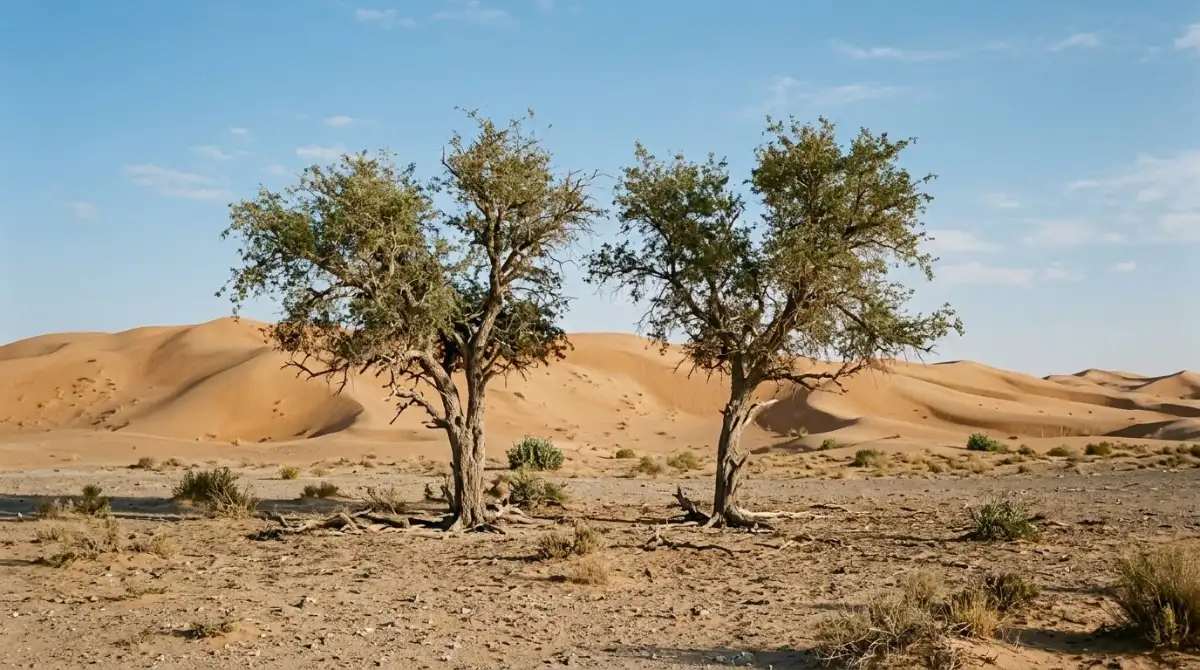
Liwa Oasis: Fifty Villages Holding the Line Against the Empty Quarter
There is no pool with palm trees around it — there is something better: a hundred-kilometre crescent of working date farms on the rim of the world’s largest sand desert, three hours from the capital.
- 230–250 km south
- ~50 villages
- Tarmac all the way
Visitors arrive in Liwa looking for “the oasis” — a pond, palms, somewhere to point a camera — and cannot find it. That is because the water is under their feet: groundwater beneath the sand, feeding a crescent of date farms that has held this edge of the Empty Quarter for centuries.
Once you stop looking for a pool and start seeing the line — green villages against the largest sand desert on earth — Liwa becomes what it actually is: the most quietly moving place in the emirate.
A hundred kilometres of green against the sand
Liwa is an arc of around fifty settlements running roughly a hundred kilometres east–west along the northern edge of the Rub al Khali, with the town of Mezaira’a at its centre — about 65 km to the crescent’s eastern end and 45 km to its western.
Every village is the same equation: date palms over groundwater, dunes behind. The palms are the oasis; there is no single spring to visit, and guides that promise one are selling the wrong picture.
South of the farms the dunes rise toward the deep desert — the scale that made Liwa’s dunes and Tel Moreeb famous.
Before the towers, this was the capital of things
Liwa is the ancestral home of the region’s ruling families and was the centre of inland life long before the coast grew its skyline. The pattern of the old economy still explains the place: dates from the farms, pearls from the sea — men leaving seasonally for the pearl banks while the villages kept the palms alive.
Date farming here is an industry, not a heritage display — drip irrigation, greenhouses, and a July date festival that is a serious agricultural competition with hundreds of farmers and millions of dirhams in prizes.
Stand between a working farm and a four-hundred-year problem of sand, and the coffee ritual at every desert camp in the country suddenly has its context.
Drive the crescent, stop where the palms do
The way to see Liwa is simply to drive the crescent road: villages, forts, farm gates and dune views alternating for an unhurried couple of hours, with Mezaira’a for fuel and lunch.
Pair it with the dunes’ showpiece — the sealed road to Moreeb Dune — and the day has both halves of the Liwa equation: the green line and the sand that besieges it.
Sunset from any high shoulder along the crescent, palms below and Empty Quarter behind, is the photograph people frame — and it needs no ticket at all.
Tarmac, one hotel, and honest logistics
230–250 km from Abu Dhabi, 2.5–3 hours each way, sealed tarmac throughout — villages, crescent and the Moreeb road included. No 4×4 needed unless you leave the road, which casual visitors should not.
Staying over: options are few and simple — a budget hotel in Liwa town and organised camping through the Liwa Sports Club — and that scarcity is part of why the place still feels remote. The Liwa overnight page weighs them.
Season: October to March. Summer in the deep south is the fiercest in the country.
We arrange private Liwa day trips and overnights, quoted plainly on WhatsApp for your group — and the drive is honest in both directions: five to six hours of road for the day.
Come for the meaning, not the convenience
Liwa rewards a specific visitor: one with a full day or a night, a feel for landscape and history, and no small children counting the kilometres.
If what you want is dune bashing, a camel and dinner by a fire, that is a superb evening — and it is an hour away at Al Khatim, not three. We would rather point you there than sell you the long road for the wrong reasons.
And if the crescent has caught you the way it catches some people: everything worth doing in Liwa is the next page.
Liwa Oasis — your questions
Where is the Liwa Oasis?
Along the northern rim of the Empty Quarter, 230-250 km south of Abu Dhabi – about 2.5 to 3 hours by road. It is not one oasis but a hundred-kilometre crescent of around fifty villages, with Mezaira’a as its centre.
Why is Liwa famous?
It is the ancestral home of the region’s ruling families and the old heart of inland Abu Dhabi – date farms fed by groundwater on the edge of the world’s largest sand desert, in the same families for generations.
Can you visit the date farms?
You see them everywhere – the crescent is a working agricultural belt, not a museum. The July date festival at Liwa is the serious annual event, an agricultural competition with millions of dirhams in prizes.
Is there literally a pool of water to see?
No – that is the misunderstanding that disappoints people. The water is groundwater under the sand, reached by wells and roots. The ‘oasis’ is the green line of palms itself.
Do I need a 4×4 to visit Liwa?
Not for the villages – the whole crescent and the road to Moreeb Dune are sealed tarmac. You need a 4×4 and experience only to leave the road, which casual visitors should not.
Can you arrange a Liwa trip?
Yes – private car day trips and overnights, quoted plainly on WhatsApp for your date and group. And when the honest answer is that Al Khatim an hour away serves you better, we say that instead.
Read next
The dunes themselves on the Liwa desert page and Moreeb Dune; the night version on Liwa overnight; the full activity list on things to do in Liwa. The one-hour alternative: the Al Khatim safari.
Three hours to the edge of the Empty Quarter
Tell us your date and group and we will quote the Liwa day or overnight plainly — or tell you honestly that Al Khatim serves your plan better. Nothing paid in advance.