
Conservation in Abu Dhabi: The Oryx Came Back — Here Is What That Bought
The emirate’s signature conservation story, the reserves it built around it, and an honest accounting of where a tourist evening on the dunes fits — footprint, rules, and no invented leaf logos.
- Oryx: back from extinct
- Reserves across habitats
- No fake eco-badges
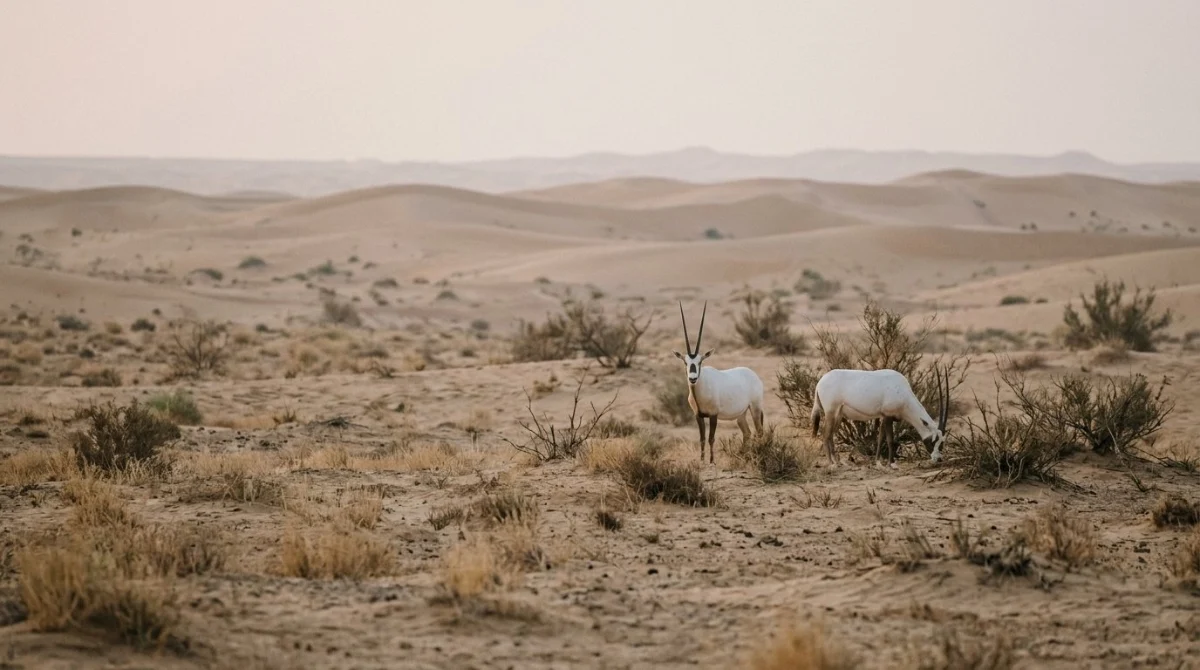
The animal on this page was extinct in the wild within living memory. That it stands in Abu Dhabi’s desert again is one of conservation’s few clean victories — and the story shapes how this emirate treats its sand, sea and visitors’ tour operators alike.
Here is that story, the protected map it produced, and our own honest ledger as one of the businesses working on the desert’s edge.
From zero to vulnerable — the right direction
By the early 1970s hunting had emptied Arabia of its wild oryx entirely. The species survived in captive herds — Abu Dhabi’s prominent among them — and decades of breeding and reintroduction returned it to the sand, making it the first animal ever downgraded from “extinct in the wild” back to “vulnerable”.
The white antelope with the straight horns is now the region’s conservation flagship — on logos, in reserves, and occasionally, at dawn, on actual dunes.
It is also a standing argument: extinction here was reversed by deliberate, funded, patient policy. Deserts reward exactly that temperament.
Desert, wetland and sea, quietly protected
Around the flagship grew a protected map most visitors never notice: reserves across the emirate’s desert, wetland and marine habitats — oryx ranges in the deep sand, flamingo wetlands within sight of the city, seagrass and turtle waters off the coast.
Access varies by design — some reserves open seasonally to visitors, others are research-only — so check official channels for what is currently visitable rather than trusting any tour site’s list, ours included.
For the guaranteed encounter with the desert’s cast, Al Ain Zoo remains the honest recommendation, and the animals page sets safari expectations truthfully.
What a safari costs the desert, and what we do about it
Honesty first: vehicle tourism has a footprint — engines, tracks, a camp’s nightly operation — and an operator claiming otherwise is selling a feeling.
What bounds ours: established routes on a long-used dune area rather than fresh sand each night; one shared supplier camp rather than proliferating builds; no wildlife performances beyond the falcon photograph; and a flat rule that everything carried in leaves with us.
What you will not find: an eco-certification we do not hold or a leaf drawn next to our logo. On this site, per the choosing-a-company page, unverifiable claims are the one pollution we refuse outright.
Five small real things
Stay on trodden sand at stops — the crust that binds a dune’s surface takes years to reform. Take every scrap back; the desert preserves litter like a museum. Refill rather than single-use where you can. Never feed or chase anything with a pulse. Give the ghaf trees room — the national tree grows slower than reputations.
None of it costs a dirham of the evening’s joy, and collectively it is the difference between tourism the desert absorbs and tourism it wears as scars.
The desert has hosted guests for four thousand years. The whole art is leaving it able to host four thousand more.
Conservation — your questions
What is the Arabian oryx story?
Hunted to extinction in the wild by the early 1970s, saved by captive herds – Abu Dhabi’s among them – and reintroduced so successfully it became the first species ever moved back from ‘extinct in the wild’ to ‘vulnerable’. It is the emirate’s conservation signature.
Does the desert safari harm the desert?
Vehicle-based tourism has a footprint and pretending otherwise would be marketing. Ours is bounded: established routes on a well-used dune area, a shared camp rather than new builds, and a leave-nothing rule – the honest version of ‘eco’.
Are there protected areas in Abu Dhabi?
Yes – the emirate maintains protected reserves across desert, wetland and marine habitats, from oryx ranges to flamingo wetlands near the city. Access varies; some open seasonally, some are research-only.
Is your safari ‘eco-certified’?
No, and we won’t invent a leaf logo. What we can honestly claim: established routes, a shared camp, no wildlife shows beyond the falcon photo, and everything carried out that we carry in.
What can visitors do to help?
Small real things: stay on trodden sand, take every scrap of litter back, skip single-use bottles where you can, never feed or chase anything, and give the ghaf trees their space – the desert’s slowest residents deserve the most care.
Why does conservation matter in a desert?
Because ’empty’ is a costume: the desert runs a full ecosystem on almost nothing, which makes it the most fragile kind of abundance. A landscape that took millennia to balance can be scarred by one afternoon of careless driving.
Read next
The ecosystem in full on the UAE desert, the honest safari cast on the animals page, and the desert’s own biography on the Abu Dhabi desert.
An evening the desert can afford
Established routes, a shared camp, nothing left behind, nothing invented on this page. From AED 35, and the oryx approves of the no-deposit policy.