The Bedouin Camp: What Is Tradition, What Is Theatre, and Why Both Are Fine
Coffee from a dallah is real hospitality; the fire show is entertainment. A desert camp works best when somebody tells you which is which — so here is the honest anatomy of an evening at ours.
- Al Khatim, ~1 hr out
- 18 inclusions from AED 35
- Overnight AED 450
Every desert camp in the Emirates calls itself Bedouin, and the word deserves better than being a font choice. The Bedouin were the desert’s pastoral peoples, and their hospitality culture — coffee, dates, shade, the guest’s precedence — genuinely survives across the Gulf.
A modern camp is an evening built in that tradition, plus stagecraft. The honest page is the one that separates the layers — and enjoys both.
Coffee, dates, carpets: the living part
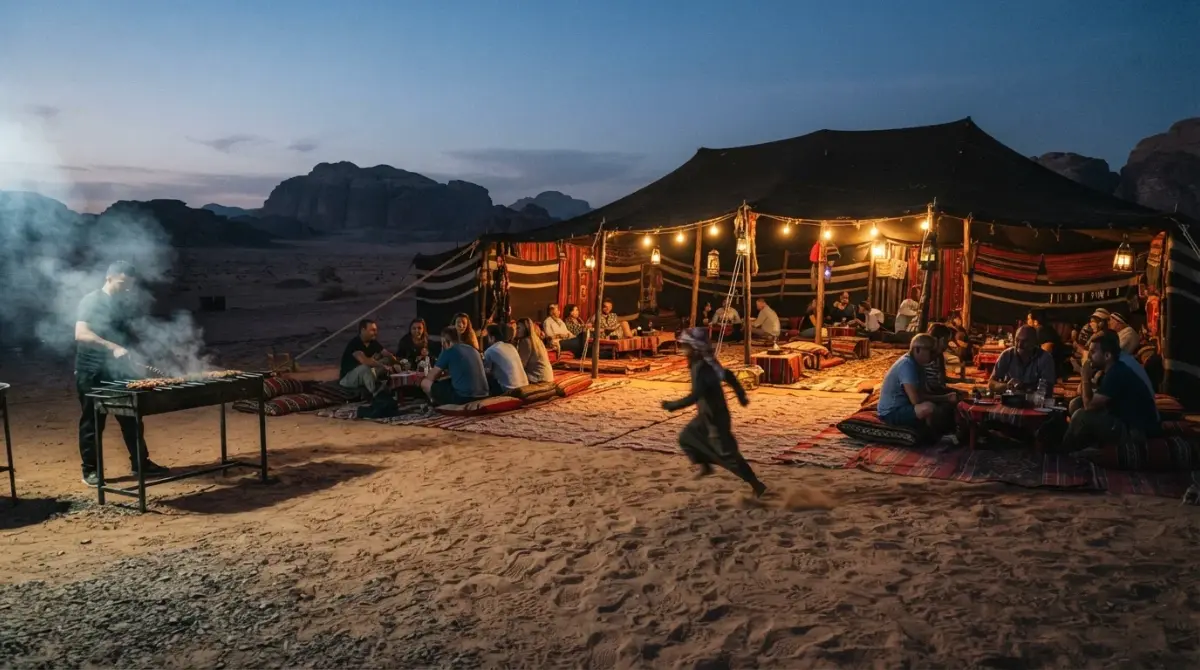
The camp’s real inheritance is its hospitality grammar: gahwa poured from the brass dallah into small cups, dates offered first, majlis seating arranged for conversation, meat over flame. None of this was invented for tourists — it is how guests are still received in Emirati homes.
The setting is equally unfaked: open dune desert at Al Khatim, an hour from the city, cold at night in winter and vast in every direction. The falcon on its handler’s glove belongs to a practice older than any country on the map.
And a plain disclosure we repeat wherever it fits: the camp is a supplier’s, shared with other operators. What is ours is your booking, vehicle, driver and price — and the honesty of pages like this one.
Tanoura, fire, belly dance: the staged part
The evening’s show sequence is entertainment, and saying so costs the camp nothing. Tanoura is an Egyptian Sufi-derived spectacle; the fire act is circus craft; belly dance is cabaret with a long Middle Eastern pedigree. Wonderful, and not ancient Bedouin custom — anyone claiming otherwise is decorating.
The same goes for the sandboards and quad bikes: the desert as playground is a modern gift, and the camp offers it without pretending your grandfather’s caravan carried snowboards.
Guests who know which layer they are enjoying enjoy both more — that is this page’s entire thesis.
Eighteen inclusions, one shape
The standard evening at the camp: arrival off the dunes at dusk, camel rides, sandboarding, henna, costume photos, the falcon, shisha corner, unlimited gahwa, karak and soft drinks — then the BBQ buffet off the live grill and the shows, fire last against full dark.
All eighteen inclusions ride on every package, from AED 35 self-drive to AED 100 collected — the ladder is transport, never a better camp. Prices and timings holds the table; the menu page holds the food, station by station.
Six hours door to door, home around half past nine, and the fire show is the part children re-enact for a week.
When the buses leave, the camp becomes itself
The camp’s best hour is its least sold: after the evening groups go, the overnight guests (AED 450) keep the fire, the quiet, and a sky the city never shows. A Bedouin-style tent, dawn over the dunes, breakfast, and the drive home.
That night is the closest the modern evening comes to the old desert’s actual texture — not the shows, but the silence they interrupt.
For the full pilgrim’s version, Liwa waits three hours south; for tonight, the camp is an hour and one message away.
The camp — your questions
What is a Bedouin camp?
A camp built in the style of the desert’s traditional hospitality: carpets and low seating around a central area, tents, a fire, coffee poured from a brass dallah, food cooked over flame. Modern camps are an evening venue in that tradition, not a claim that Bedouin life continues unchanged inside them.
Is the camp on your safari a real Bedouin camp?
It is a working desert camp at Al Khatim built in Bedouin style, run by a supplier we work with alongside other operators – we say that plainly rather than inventing ownership. The sand, food, coffee and fire are real; the shows are entertainment and we label them as such.
What happens at the camp in an evening?
Camel rides, sandboarding, henna, Arabic costume photos, the falcon, shisha corner, unlimited coffee and soft drinks, a BBQ buffet off the live grill, and the show sequence ending with fire – eighteen inclusions on every package from AED 35.
Can you sleep at a Bedouin camp?
Yes – the overnight safari at AED 450 keeps you after the evening guests leave: the quiet camp, the fire, a Bedouin-style tent, and sunrise over the dunes with breakfast before the drive back.
What is majlis seating?
The traditional arrangement – carpets and cushions around a shared space, built for conversation and coffee. At the camp it is the default seating; a front-row bay with backrests is AED 50 for those who want the tradition with lumbar support.
Is the coffee ritual real or staged?
Real in the sense that matters: gahwa from a dallah with dates is how hospitality is still offered across the Emirates, at homes and majlis gatherings, not just camps. The camp serves it the way it is actually served.
Read next
The traditions in detail: the majlis, falconry, tanoura and the camp menu. The visits: the evening and the overnight.Camping in Abu Dhabi
Coffee is poured either way — come for an evening or stay the night
From AED 35 for the evening to AED 450 for the night under stars, with the honest labelling included free. Nothing paid in advance.