
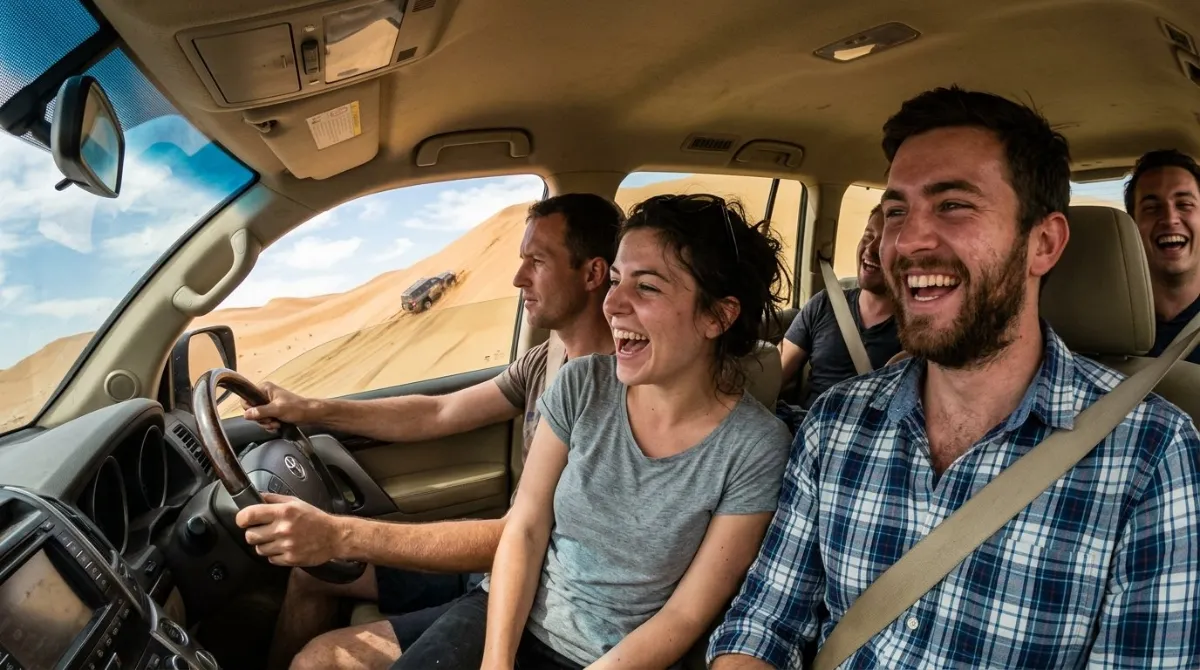
Is a Desert Safari in Abu Dhabi Safe? The Checkable Answer
Yes — and the reasons are things you can verify rather than promises. This page also says which parts of the evening carry real risk, because it is not the part people worry about.
- 7 min read
- Dune drive 30–45 min
- Adjustable or skippable
“Is it safe” is the question people type at eleven at night after watching a video of a car sliding sideways down a dune. It is a fair question and it deserves a better answer than the one most operators give, which is the word yes followed by a booking button.
So here is the useful version: what the actual risks are, in order, which of them you can check for yourself, and which parts of the evening you can turn down or leave out.
The real risks, in order
Ranked honestly, the dune drive is not at the top.
1. The road, both ways. Forty-five minutes to an hour of highway each way, and the return leg is at night. This is the ordinary risk of any road journey in any country and it is the largest single one in the evening. It is also the argument for a proper operator with a professional driver rather than a hire car and a map.
2. Heat, if you get the season or the timing wrong. Real between May and September, and entirely avoidable — see below.
3. The dune drive. Controlled, adjustable, and the part with the most engineering behind it. It is also the part you can decline.
4. The optional engines. Quad bikes and buggies carry more risk than anything else on the programme, precisely because you are driving. They are add-ons; nothing obliges you to take one.
5. Everything at the camp. Sitting on carpets eating grilled food. This is where most of the evening happens and there is very little to say about it.
Notice the shape of that list. The risks are concentrated in the parts that feel ordinary, and the part that looks frightening in videos is the part with a roll cage around it.
Three things you can check
Safety claims are worth nothing unless you can test them. These three you can, with any operator, in about a minute.
Does the car have an internal roll cage? Not factory pillars — a proper cage you can see inside the cabin. Ours are Toyota Land Cruisers with a full internal cage and four-point belts in the rear.
Does the driver check the belts before the first dune? Watch for it. A driver who checks every belt rather than assuming is telling you what kind of operation this is.
Do the tyres come down before the sand? They should drop from around 35 psi to near 15 at a stop before the dunes. That widens the contact patch so the vehicle floats over soft sand instead of digging into it. If a car drives straight from tarmac onto dunes at road pressure, get out.
The mechanics of all of this — why the tyres, why the cage, how the driver reads a slipface — are set out in full on the dune bashing page.
Heat, water and the time of day
Almost nothing about a standard safari happens at the hottest part of the day. You are collected in the late afternoon, you reach the dunes as the sun drops, and the camp cools steadily from then on. That single piece of scheduling removes most of the heat risk from May to September.
What catches people out is not the temperature, it is the water. Guests rarely get dehydrated at the camp, because water, soft drinks and tea are unlimited and sitting in front of them. They get dehydrated during the day, before pickup, walking around the city. The flatness people blame on the desert was usually banked hours earlier.
If you are travelling between May and September, read the summer safari page before you book. If heat is your main worry, the best time to go guide compares all twelve months with real figures rather than the usual “pleasant year-round” line.
Who should not do the dune drive
These are firm, and telling us when you book costs nothing:
| Condition | The dune drive | The rest of the evening |
|---|---|---|
| Pregnancy | No | Fine — we take the graded track to camp |
| Heart condition | No | Fine |
| Back or neck problem | No | Fine |
| Recent surgery | No | Fine |
| Children under three | No | Fine — the camp is flat and safe |
| Prone to motion sickness | Gentle route, or skip | Fine — details here |
The point of that table is the right-hand column. Skipping the dunes does not mean skipping the safari. The driver takes the firm graded route straight to the camp, and the camel ride, sandboarding, shows, dinner and stars are all unchanged, at the same price.
Children
Children can do the dune drive from age three. Below that there is no seat arrangement that makes it appropriate, and we will say so rather than take the booking.
At the camp itself there is very little to manage. It is flat, it is lit, the food is served buffet-style and there is a lot of sand to play in. The two things worth watching are the fire show, which has a clear area around it that children should stay behind, and the sand at the top of the sandboarding dune, which stays hot for a while after sunset in summer.
Winter evenings catch families out more than summer ones. Children feel the night-time drop before adults do, and December at the camp gets genuinely cold. Bring a layer. The family safari page goes through the ages properly, and what to wear covers the layers by month.
Safety at the camp
No alcohol. Not served, not sold, and not permitted to bring. That is worth saying in a safety context rather than only a cultural one: there is no drinking crowd at this camp, which changes the atmosphere completely and is one reason families and solo travellers are comfortable here.
The quads and buggies. Helmet and briefing first, and a marked track for anyone who has not ridden before. If you have never been on one, take the camp track rather than the open-dune session for your first thirty minutes. Everything is priced and explained on the activities page.
The camels. Led at walking pace by a handler, with a mounting block. The moment to hold on is when the animal stands up and sits down, which is when it tips forwards; the handler will tell you.
The fire show. Performed at a distance with a clear area. Stay behind it and keep small children in front of you rather than roaming.
Washrooms. There are separate washrooms at the camp. They are desert-camp standard rather than hotel standard — they exist, they are basic, and they work.
Phone signal and what “in the dunes” means
Signal is usable near the road and unreliable once you are properly into the dunes. Most people find that is the best part of the evening; a few find it uncomfortable, and if you are one of them it is worth knowing before you go rather than discovering it an hour out.
Two practical points. Tell someone your plan and roughly when you will be back — the same thing you would do anywhere. And keep the WhatsApp thread with us on your phone, because it has the date, the pickup and the total in writing, and it is the fastest way to reach a real person before and after the trip.
Vehicles do not go out alone into the dune field. On a standard evening they move as a group, which is the practical reason a stuck car is an inconvenience rather than a problem.
First aid, and who to call
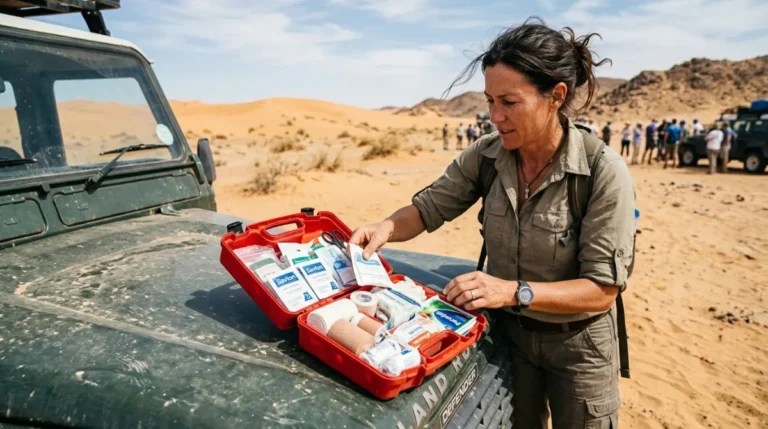
Our drivers are trained in basic first aid, and a first aid kit travels in the vehicle — not locked in a store room at the camp, but with the person who is beside you all evening. For anything beyond a scrape, the driver has contact with the camp and the other vehicles, and the convoy means another car is always minutes away.
Worth having in your head rather than needing to look up: the UAE ambulance number is 998, nationwide. In practice the sequence on the rare bad day is simpler — tell your driver, and he handles the rest.
Safety questions we actually get
Is a desert safari in Abu Dhabi safe?
Yes, when the vehicle has an internal roll cage and working belts, the driver checks them before the first dune, and the tyres are aired down from about 35 psi to 15 before the sand. Those three things are checkable on the day. The dune section can also be made gentle or skipped entirely at no extra cost.
Is dune bashing dangerous?
It is the part that looks most dangerous and is among the most controlled. The cars are built for it, the drivers do it daily on the same dune field, and the intensity is set by whoever in the car asks for the least of it. Statistically the highway drive out and back is the larger risk in the evening.
Can I do a desert safari while pregnant?
Not the dune drive — that is a firm no. The rest of the evening is fine: the driver takes the graded track straight to the camp and you keep the camel ride, the food, the shows and the stars at the same price. Tell us when you book so the timing is set up for it.
Is a desert safari safe for children?
The dune drive is suitable from age three. Younger children can still come and go straight to the camp, which is flat, lit and easy. Watch the fire show distance and bring a layer in winter, because children feel the night-time drop before adults do.
Is there alcohol at the desert camp?
No. Alcohol is not served, not sold and not permitted to bring, and it is not used in the cooking. It is a family camp, and the absence of a drinking crowd is one of the reasons it suits families and people travelling on their own.
Will I have phone signal in the desert?
Usable near the road and unreliable in the dunes. The vehicles travel as a group rather than alone, so a stuck car is an inconvenience rather than a problem. Keep our WhatsApp thread on your phone — it is the quickest way to reach a person.
Read next
The mechanics of the drive — the cage, the belts, the tyre pressures — are on the dune bashing page. If travel sickness is the worry rather than safety, this page covers the gentle route and the skip option. For heat, read summer safaris or compare the months on best time to go. Booking without handing over money in advance is explained on pay on arrival.
Tell us the concern and we will tell you straight
A pregnancy, a bad back, a nervous child, a fear of the drive — send it over. If the trip is not right for someone in your group we will say so, and if it is we will set it up around them. Nothing is taken until you are at the camp.