
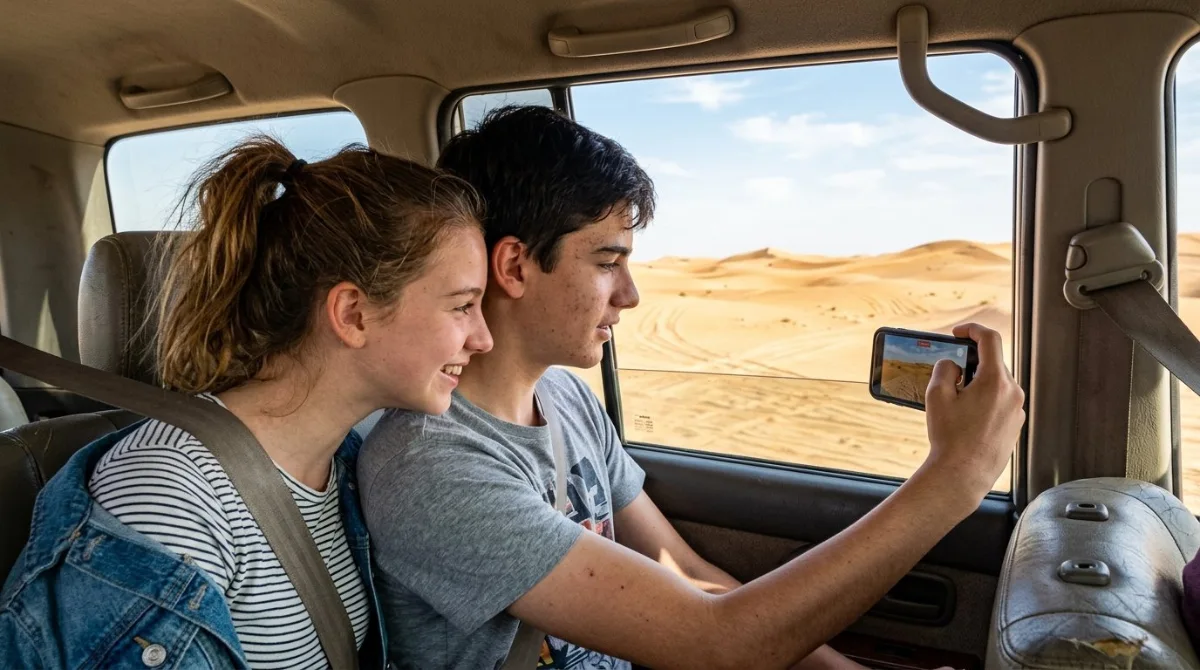
Phone Signal in the Abu Dhabi Desert: What You Get and What You Do Not
Usable near the road, unreliable once you are in among the dunes. For most guests that turns out to be the best part of the evening — but it is worth knowing before you go, not after.
- 5 min read
- Patchy in the dunes
- Cars travel as a group
The camp is about an hour inland from the Corniche. That is far enough to lose the city entirely — the light, the noise and, for stretches of the evening, the network.
Most people find that is the point. A few find it uncomfortable, particularly anyone who needs to stay reachable. Both are reasonable, and five minutes of preparation covers either.
What the signal is actually like
| Where | Signal | What it means |
|---|---|---|
| The drive out, on the highway | Fine | Normal coverage the whole way |
| The tyre stop, at the edge of the dunes | Usually usable | Last reliable place to send a message |
| In among the dunes | Unreliable | Comes and goes. Do not plan around it |
| At the camp | Patchy | Some evenings fine, some evenings not. It varies by network and by where you sit |
| The drive home | Fine again | Back on the road within half an hour |
The two UAE networks are Etisalat and du, and coverage inland differs between them, which is why two people sitting on the same carpet can have different experiences. Neither is reliable deep in the dune field.
One thing that is not a worry: the vehicles do not go out alone. On a standard evening they move as a group, which is the practical reason a stuck car is an inconvenience rather than a situation.
What still works with no bars
More than people expect. Your camera does not need a network. Neither does a compass app, which reads the phone’s magnetometer rather than the internet — useful if you want the qibla, which is roughly 260 degrees from Abu Dhabi.
Downloaded maps, downloaded music and anything already on the device work normally. What does not work is anything that needs to fetch: live maps, streaming, uploading the video you just shot, and any app that wants to check your location against a server.
So take the photographs, and post them from the car on the way home. They will look better after twenty minutes of choosing anyway.
Five minutes before you leave the hotel
1. Charge, and bring a power bank. Six hours out, cold nights in winter drain batteries faster, and we would not count on finding somewhere to plug in at a desert camp.
2. Download an offline map of the area. Not because you are navigating — your driver is — but because it settles most people to be able to see where they are.
3. Open your qibla or compass app once, while you still have signal. A compass works offline; an app that has to fix your position first does not.
4. Keep our WhatsApp thread on your phone. It has the date, the pickup window and the total in writing. That is your booking, and it is the fastest way to reach a real person before and after.
5. Tell someone your plan. Roughly where you are going and roughly when you will be back — the same thing you would do anywhere.
Photographs, which is what you actually want it for
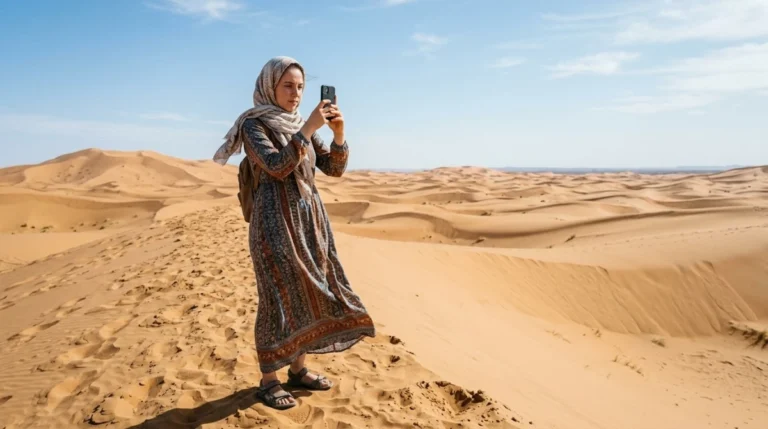
The hour around sunset is the reason to have the phone out at all. Two practical notes.
Do not film during the dune drive if you are prone to travel sickness. Looking at a screen while the car pitches is the fastest route to feeling awful — the motion sickness page covers the rest.
The sunset stop is the shot. Everyone gets out, the light is low and raking across the ripples, and there are a few minutes with nobody rushing you. The camel line at the camp afterwards is the other one.
If photographs are the main reason you are coming, a private car is what buys you time rather than a schedule set by five other pickups.
Signal and phone questions
Is there phone signal at the desert camp in Abu Dhabi?
Patchy. It is usable near the road and unreliable once you are properly in among the dunes, and at the camp it varies by network and by where you are sitting. The drive out and back has normal coverage.
Is there WiFi at the desert camp?
Do not count on it. Plan the evening as an offline one: take your photographs, and upload them from the car on the way home when the signal returns.
Can I charge my phone at the desert camp?
We would not rely on it. Charge before you leave and bring a power bank, especially in winter when the cold drains batteries faster and the evening runs six hours door to door.
What if there is an emergency and I have no signal?
The vehicles travel as a group rather than alone, so you are never out there by yourself. Tell someone your plan before you go, and keep our WhatsApp thread on your phone — the drive back reaches coverage within about half an hour.
Which network works best in the Abu Dhabi desert?
Coverage inland differs between Etisalat and du, which is why two people on the same carpet can have different luck. Neither is reliable deep in the dune field, so plan for no signal rather than choosing a network for it.
Will my maps work in the desert?
Only if you download the area in advance. Live maps need a connection. A compass app works offline because it uses the phone’s own sensor, but open any app that needs your position while you still have signal.
Read next
What to pack and wear is on what to wear, and the evening hour by hour is on the first-timer’s guide. For prayer timings and the qibla out there, see prayer times. The wider question of being an hour from the city is covered on is it safe?, and everything else is gathered on before you book.
Send the question while you still have signal
Anything you want confirmed — pickup time, what is included, the total — ask before you set off and you will have it in writing on your phone, which works whether or not the network does.