
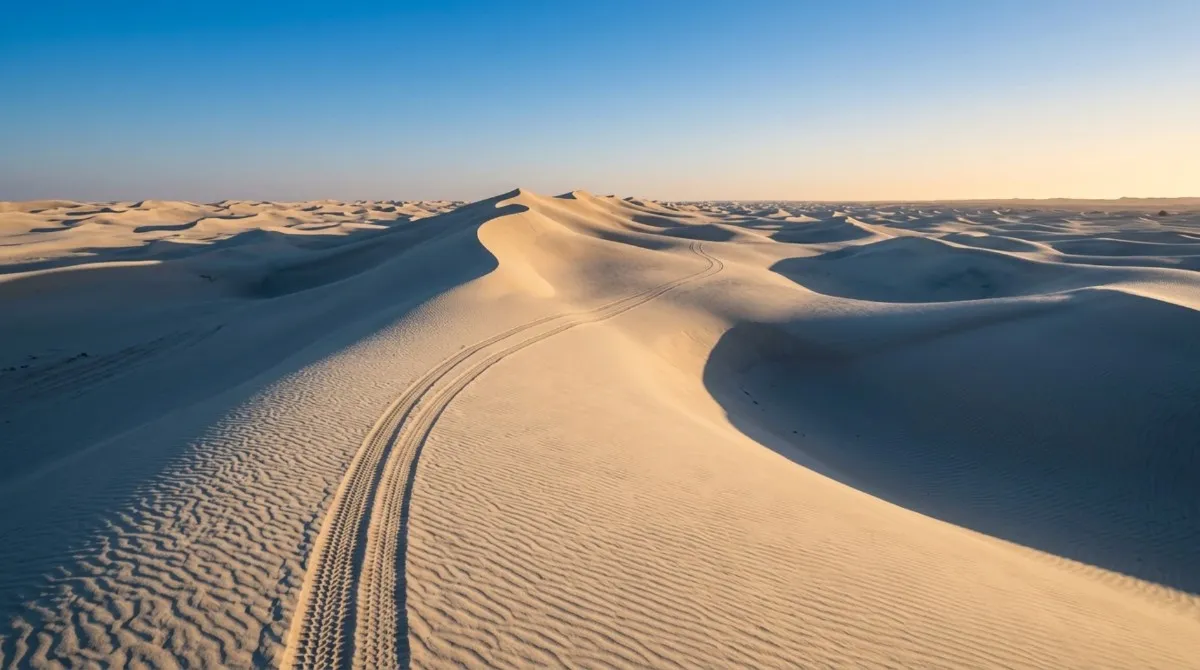
Morning Desert Safari Abu Dhabi
Cool sand, empty dunes and the best light of the day — dune bashing, camel ride, sandboarding and breakfast at the camp. Back in the city before lunch.
- Daily, all year
- Pickup 6:00–6:30 AM
- Back by 11:30 AM
- About 5 hours
- No deposit
Six things you will do before noon
The same desert, the same camp and the same drivers as the evening safari — at the hour when the sand is cold, the light is low and there is almost nobody else out there.
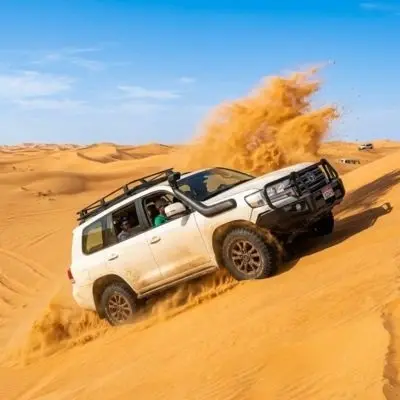
Dune bashing on firm sand
Overnight cold packs the sand tighter, so the car holds a line the afternoon dunes will not give you. Drivers who do both shifts will tell you the morning drive is the better one. Thirty to forty-five minutes across the ridges, and the same rule applies: say the word and it gets gentler.
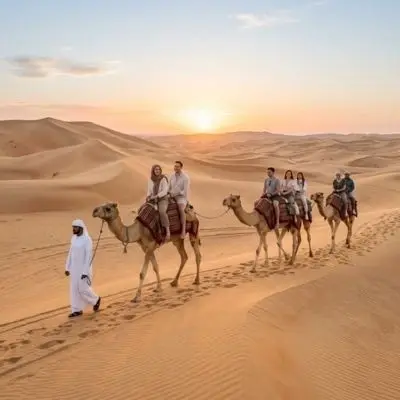
Camel ride in cool air
Camels are far more willing at seven in the morning than at five in the afternoon, and so is everybody else. The light is soft, the shadows are long, and you are not queuing behind three coachloads of people.
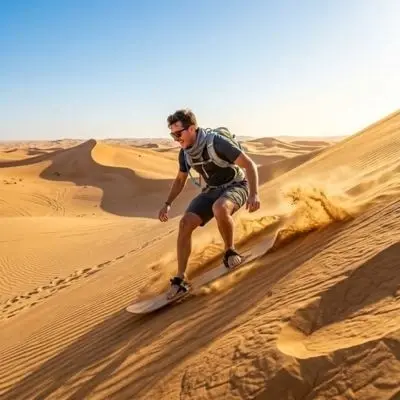
Sandboarding before the heat
The slope is cool enough to walk back up barefoot, which in the afternoon it very much is not. Boards and wax are provided and there is no time limit and no charge.
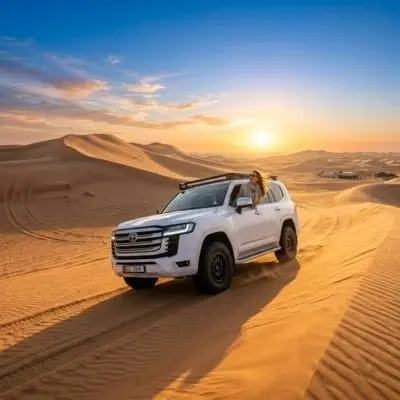
The light
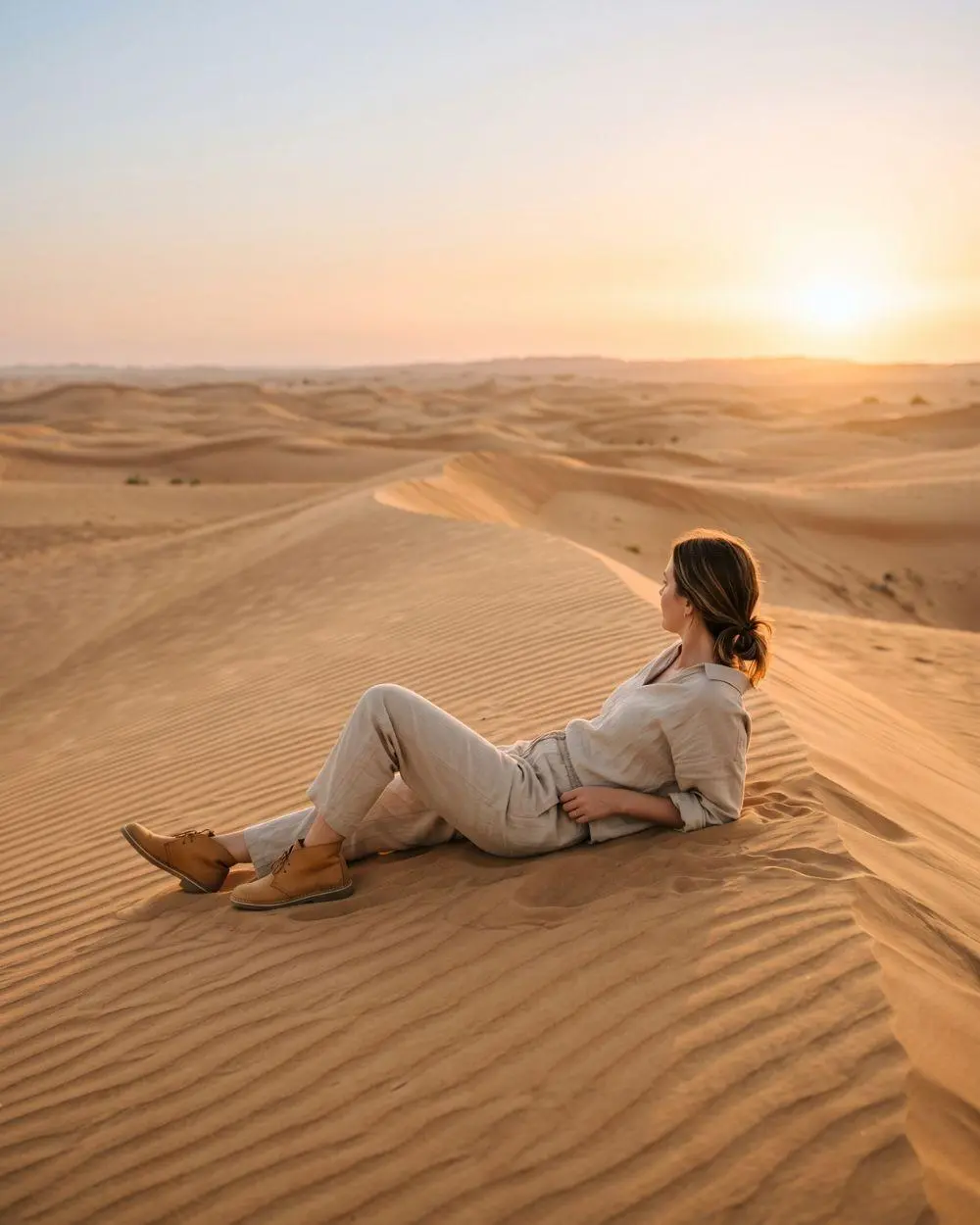
This is the real reason to book the morning. Between about six and eight the dunes hold a low raking light that photographers travel for, with clean blue shadow in every hollow and no haze. By ten it has gone flat.
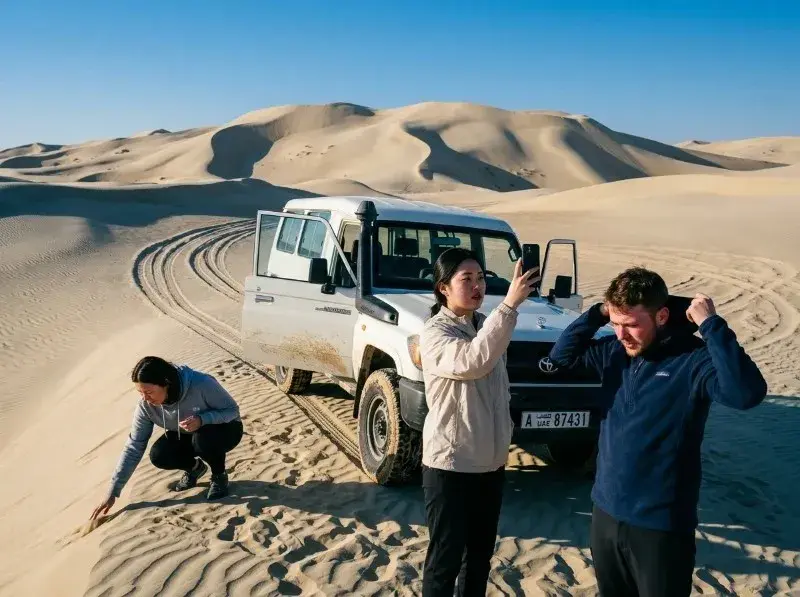
Breakfast at the camp
Arabic coffee, tea, fresh dates, fruit, breads and a hot breakfast at the camp. Not a buffet the size of the evening one, and it is not meant to be, but nobody leaves hungry.
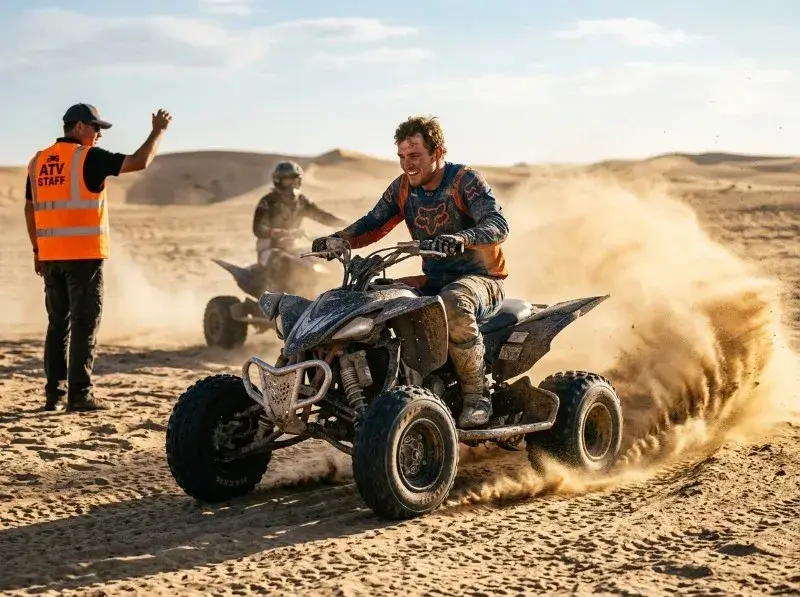
Quads, if you want them
The track runs in the morning too, from AED 100 for a single rider. Riding a quad at seven in the morning in twenty-two degrees is a different sport to riding one at four in the afternoon in forty-one.
What AED 799 actually covers
Twelve things, all of them included, with hotel pickup in a Land Cruiser. Below that, the honest list of what the morning does not have.
- Hotel or residence pickup and drop in a 4×4 Land Cruiser
- Dune bashing on cool, firm morning sand
- Short camel ride at the camp
- Sandboarding, boards and wax provided
- Welcome Arabic coffee, tea and fresh dates
- Unlimited water, tea and soft drinks
- Hot breakfast at the camp, halal, veg and non-veg
- Fresh fruit, breads and Arabic pastries
- Bedouin tent and carpet seating
- Arabic costume photo corner
- Time on the dunes for photographs
- Separate ladies and gents washrooms
What the morning does not include
Worth reading before you choose between morning and evening.
- Live shows — belly dance, tanoura and the fire show run in the evening only
- Quad bikes, dune buggies and long camel rides (priced below)
- Henna painting, which the camp runs in the evening
- Alcohol — the camp is dry
- Professional photography, from AED 50
- Travel insurance
The promise: every price on this page is the price. Nobody at the camp will quote you a different number, and there is no service charge at the end.
An early start, and worth it
The whole point of the morning safari is being on the sand before the sun is high. That means an early alarm. Pickup shifts by about forty minutes between winter and summer because sunrise moves.
| Stage | Winter (Oct–Mar) | Summer (Apr–Sep) |
|---|---|---|
| Pickup from your hotel or residence | 6:30–7:00 AM | 5:45–6:15 AM |
| Arrive at the dunes | about 7:30 AM | about 6:45 AM |
| Dune bashing | 7:30–8:15 AM | 6:45–7:30 AM |
| Photograph stop on the crest | about 8:20 AM | about 7:35 AM |
| Camp: camel, sandboarding, costume corner | 8:30–9:30 AM | 7:45–8:45 AM |
| Breakfast at the camp | 9:30–10:15 AM | 8:45–9:30 AM |
| Leave camp | about 10:30 AM | about 9:45 AM |
| Back at your hotel | 11:00–11:30 AM | 10:15–10:45 AM |
In July and August we start earlier still, because by nine in the morning the sand is already too hot to walk on barefoot. We confirm your exact pickup time on WhatsApp the evening before.
Morning desert safari prices
Unlike the evening, the morning runs on hotel pickup only — there is no shared bus and no self-drive option, because the camp does not open its gate to private cars before eight.
Morning Desert Safari
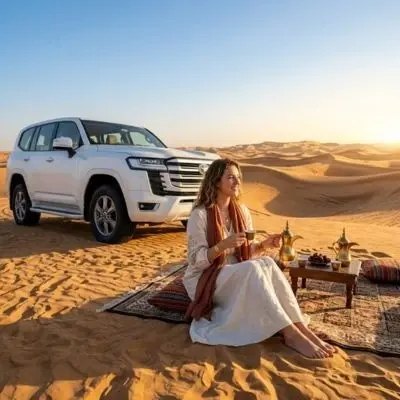
Private sedan or SUV, hotel pickupA car collects you from your door before dawn and stays with you until you are back. Your group only, up to six seats. Dune bashing, camel, sandboarding and breakfast at the camp. At six people that is about AED 133 each.
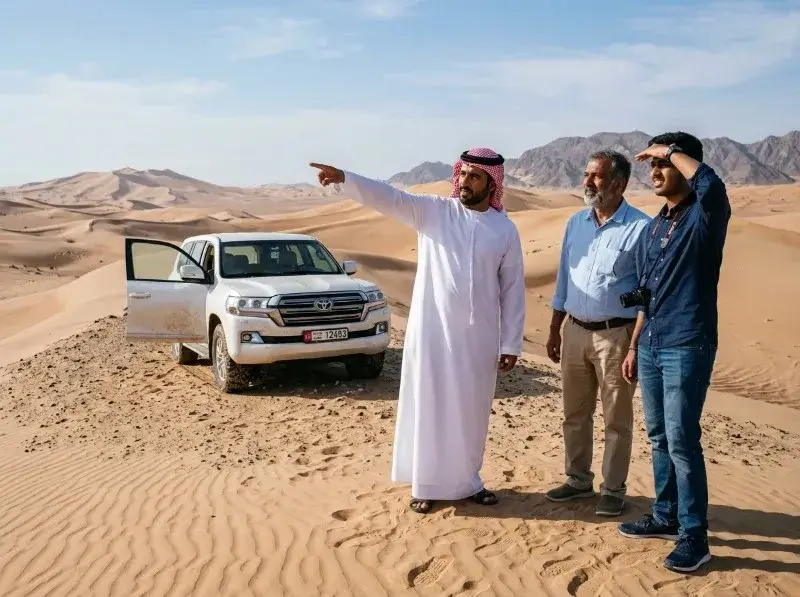
Morning Safari, Land Cruiser
The bigger 4×4, up to sixThe same morning in a Land Cruiser instead of a sedan or SUV — more room, higher off the sand and a firmer ride over the dunes. Worth the difference if there are five or six of you or if anyone gets travel sick.
Sunrise Safari
Private Land Cruiser, out before first lightThe same desert an hour earlier, timed so you are standing on a crest as the sun clears the horizon. Arabic coffee on the dune, then breakfast. If photographs are the reason you are booking, this is the one.
Children under five come free sharing an adult seat. From five, everyone pays the standard rate. For ten or more, message us for a group rate.
Every extra, priced in advance
The same published prices as every other Golden Dunes safari. Nothing is invented at the camp.
| Add-on | What it is | Price |
|---|---|---|
| Quad bike, single | One rider on the marked track | AED 100 |
| Quad bike, double | Two riders, at the camp | AED 150 |
| Long camel ride | Beyond the short ride already included | AED 300 |
| Long dune bashing | About 30 minutes, private Land Cruiser | AED 150 |
| Falcon photography | Hold the falcon, keep the photo | AED 30 |
| Professional photography | Cameraman at the camp | AED 50–150 |
Sheesha and VIP majlis seating are evening-only — the camp does not run them in the morning.
What actually happens out there
Winter times shown. In summer everything moves about forty-five minutes earlier.
We collect you
Your driver messages when he is outside. It is dark, it is quiet, and the roads are empty in a way Abu Dhabi never is again until the following morning.
The drive out
Under an hour, and faster than the evening run because there is no traffic to sit in. The sky goes from grey to pale gold somewhere around the halfway point.
Dune bashing
Tyres down at the edge of the sand. Overnight cold has packed the dunes firm, so the car grips where it would slide in the afternoon. This is the better drive of the two, and the drivers know it.
The photograph stop
A high crest with the light still low and raking across the ripples. Twenty minutes, no rush, and nobody else in the frame.
Camp: camel, board, costume
Camel along the crest, boards at the top of the slope, the costume corner in the tent. Everything is walkable barefoot because the sand has not heated up yet.
Breakfast
Arabic coffee and dates first, then hot breakfast, fruit, breads and pastries, sitting on carpets in the shade of the majlis.
Back to the city
You are at your hotel before half eleven with the whole day still in front of you. Most people go straight to the pool.
Which one should you actually book?
Roughly nine out of ten desert safaris sold in the UAE are evening safaris, and most people book the evening because it is the default rather than because they compared the two. They are genuinely different trips.
Book the morning if…
You care about photographs. The low raking light between six and eight in the morning is the best the desert gives all day, and the dunes are unmarked — no tyre tracks, no footprints, nothing but wind ripples. By four in the afternoon the same dunes have been driven over by every operator in the emirate.
You are travelling in summer. In July the afternoon sand hits temperatures you cannot stand on barefoot and the air is somewhere past forty degrees. At seven in the morning it is low twenties and completely pleasant. The morning safari is the only comfortable way to do the desert between June and September.
You get travel sick, or you are bringing someone who does. Dune bashing on an empty stomach at seven in the morning is far kinder than dune bashing after a day of eating.
You have one day in Abu Dhabi. The morning safari puts you back at your hotel before half eleven, which leaves the Grand Mosque, Qasr Al Watan and the Corniche all still available that same day.
Book the evening if…
You want the shows. Belly dance, the LED tanoura and the fire show are evening-only, and no amount of asking will move them. The same goes for henna and sheesha.
You want the big dinner. The evening BBQ buffet is a proper spread with grilled meats, half a dozen salads, breads and dessert. Morning breakfast is good, but it is breakfast.
You do not want a five-thirty alarm on holiday. This is a completely reasonable position and we are not going to pretend otherwise.
You want the cheapest option. The evening starts at AED 35 with self-drive and AED 50 on the shared bus. The morning runs on private cars only, so AED 799 for the vehicle is the floor — which is fine value split six ways and poor value for one or two.
What the first two hours of light actually do
If you are bringing a camera, or you just want to know why everyone says the morning is worth the alarm, this is the part worth reading.
The blue hour, then the gold
The twenty-five minutes before the sun clears the horizon are what photographers call the blue hour. At Al Khatim the whole plain goes an even cold blue with no shadows at all, and the dune crests read as soft grey lines against it. It photographs completely differently to anything you will see later in the day, and most guests miss it because they are still in the car.
Then the sun comes up and the light turns hard and gold within about ten minutes. Because it is coming in almost horizontally, every ripple on the sand casts a shadow several times its own length, and the surface that looked flat at noon suddenly reads as texture. That effect is gone by about half nine, when the sun is high enough that the ripples stop casting anything.
Where to stand, if you care about the photograph
Face away from the sun rather than into it. Shooting into a low sun over pale sand blows the highlights out and the dunes come back as a white smear. With the sun behind you the sand holds its colour and the shadows do the work. If you want a silhouette, wait until the sun is a hand’s width above the horizon and put a person on the crest above you, shooting upward.
Ask your driver to stop before the dune drive rather than after. Once the cars have crossed a ridge the ripples are gone for the day, and drivers are used to being asked — nobody minds pulling up for ten minutes on the way in.
Temperature, honestly
People underestimate how cold the desert gets before dawn in winter. Between December and February the plain can sit in the low teens at six in the morning, and with any breeze at all it feels colder than that. Guests who came from a European winter find it fine; guests who packed for a Gulf holiday sometimes do not. Bring a jacket you can take off by nine.
The reverse is true in summer. A seven o’clock start in August gives you low to mid twenties, which is the most comfortable the Abu Dhabi desert gets between June and September. By half ten the same spot is past thirty-five, which is exactly why the trip ends when it does.
What is moving at that hour
The desert is at its most active in the hour either side of dawn, because most of what lives there has spent the night out and is heading for shade. Fresh tracks are everywhere on the morning drive and they are easy to read once someone points them out: the neat parallel dashes of a sand skink, the small paired prints of gerbils, the wandering line of a darkling beetle, and occasionally the clean four-toe print of an Arabian red fox heading back toward the plain.
Desert hares are common along the graded track on the way in. Ghaf trees dotted across the plain hold small birds at first light — hoopoe larks and wheatears mostly — and the ghaf itself is worth a look: it is the UAE national tree, it stays green through summers with no rain at all, and its roots reach down more than thirty metres to find water.
Why the sand looks the way it does here
Al Khatim sand is pale gold rather than the deep rust red of the Lahbab dunes outside Dubai. The difference is iron oxide content: Lahbab sand is rich in it and oxidises to red, while Al Khatim carries much less. In morning light the pale sand is the better of the two, because it holds shadow detail that red sand loses.
The dunes here are long and linear rather than short and steep, shaped by wind that blows consistently from one direction across a wide flat plain. That gives you an unbroken horizon at sunrise, with nothing between you and the light — and a smoother dune drive, since the car is running along ridges rather than climbing and dropping.
Why the morning desert is a different desert
The sand behaves differently before the sun gets to it
Desert sand loses heat fast overnight. By six in the morning the top layer at Al Khatim has cooled through and compacted slightly, and residual humidity from the night binds the grains together. The practical result is a firmer surface: a Land Cruiser holds a line across a ridge in the morning that it would wash out on in the afternoon, when the same sand is loose, dry and hot.
Drivers who work both shifts almost all prefer the morning drive. It is smoother, more predictable and, if you like the technical side of it, more interesting to watch someone do well. It also means less of the abrupt sliding that upsets passengers who are unsure about the whole idea.
You get the dunes before anybody has driven on them
Every operator in the emirate runs its main volume in the afternoon. By four o’clock the popular ridges near the camps carry tyre tracks from that day and the day before. Overnight wind smooths most of it out, so the first vehicles onto the sand in the morning get clean, unmarked dunes with nothing but wind ripples across them.
If you have seen desert photographs where the sand looks like folded silk, that is morning sand. It does not look like that at five in the afternoon, and no camera setting will get it back.
Summer changes the maths completely
Between June and September the afternoon desert is genuinely hard work. Air temperatures pass forty degrees, the sand surface goes well beyond that, and walking barefoot from the car to the majlis is not something you do twice. Guests who book the evening safari in August usually enjoy it, but they spend the first hour waiting for the sun to go down.
The morning safari sidesteps all of it. A seven o’clock start in August means low to mid twenties, a light breeze off the plain and sand you can lie on. It is the single best time of year to do the morning trip, and it is also when the dunes are emptiest, because most visitors have decided the desert is a winter activity.
It gives you the rest of the day back
An evening safari costs you the whole back half of your day: you cannot really start anything at one in the afternoon knowing a car is coming at half two, and you get home at half nine ready for bed. The morning safari is finished by half eleven.
Guests on a short stay often do the morning safari on day one and the Grand Mosque and Qasr Al Watan the same afternoon. On a one-day stopover it is the only version of the desert that fits at all.
What you are trading away
We would rather say this plainly than have you find out at the camp. The morning has no live shows, no henna, no sheesha and a smaller meal. The camp in the morning is a quieter, simpler place — carpets, coffee, breakfast and the dunes. Guests who wanted the full Arabian-night production and booked the morning because it was earlier are the only people who ever come back disappointed.
If you want both, the honest answer is to do the morning for the desert and the evening for the camp. Booked together we will work the timings out and quote you a combined rate on WhatsApp.
Morning desert safari Abu Dhabi — FAQ
How much is the morning desert safari in Abu Dhabi?
AED 799 for the whole car with hotel pickup, in a private sedan or SUV holding up to six — about AED 133 each for six. A Land Cruiser is AED 999, and the sunrise trip out before first light is also AED 999. All three are whole-car prices, not per person.
What time does the morning safari start?
Pickup is 6:30 to 7:00 AM in winter and 5:45 to 6:15 AM in summer, because sunrise moves. You are back at your hotel between 10:15 and 11:30 AM depending on the season.
Is breakfast included?
Yes. Arabic coffee, tea, fresh dates, fruit, breads, pastries and a hot breakfast at the camp, all halal, with a vegetarian option. It is included in the AED 799.
Are there live shows in the morning?
No. Belly dance, the LED tanoura and the fire show run in the evening only, and so do henna and sheesha. If those are what you came for, book the evening safari.
Is the morning safari better than the evening one?
For photographs, for summer, for travel sickness and for anyone short on time, yes. For entertainment, the big BBQ dinner and the cheapest price, the evening wins. They are different trips rather than better and worse.
Is dune bashing better in the morning?
Most drivers think so. Overnight cooling packs the sand firmer, so the vehicle holds its line instead of sliding, and the ride is smoother. The dunes are also unmarked because nobody has driven on them yet that day.
Do you run morning safaris in summer?
Every day. Summer is arguably the best time for the morning trip — low twenties at seven in the morning against forty-plus in the afternoon. We start earlier in July and August.
Can I drive myself to the morning safari?
No. The camp does not open its gate to private vehicles before eight in the morning, so the morning safari runs on hotel pickup only. Self-drive is available on the evening safari at AED 35.
Is there a shared bus option in the morning?
No. The coach runs the evening route only. The morning safari is Land Cruiser pickup from your hotel or residence.
How long does the whole thing take?
About five hours door to door, against six for the evening safari.
Is it suitable for children?
Yes. Dune bashing from age three, camel rides from about four. The early start is the only real obstacle, and most children handle it better than their parents do.
What should I wear in the morning?
Light layers. It can be genuinely cool at six in the morning between December and February — low teens is normal — and warm by ten. Closed shoes, sunglasses and sunscreen.
Do I pay anything in advance?
No deposit, no card details, nothing online. You pay cash or card at the camp, and cancellation is free up to 24 hours before pickup.
Can I add a quad bike in the morning?
Yes, from AED 100 for a single rider. The track runs in the morning too, and riding it in twenty-two degrees is a great deal more pleasant than in forty.
Other Abu Dhabi desert safaris
Same camp, same team, same no-deposit booking — a different time of day.
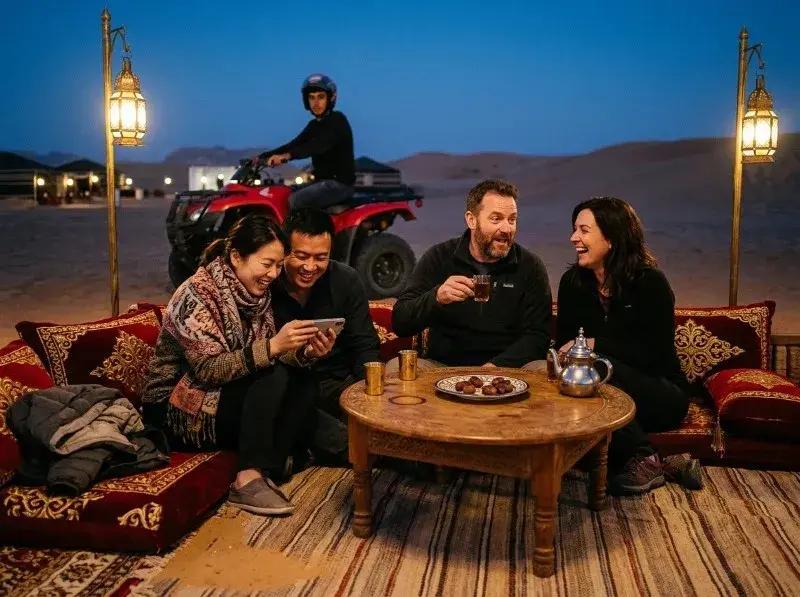
Evening Desert Safari
Sunset dune drive, live shows and the full BBQ buffet under the stars.
from AED 35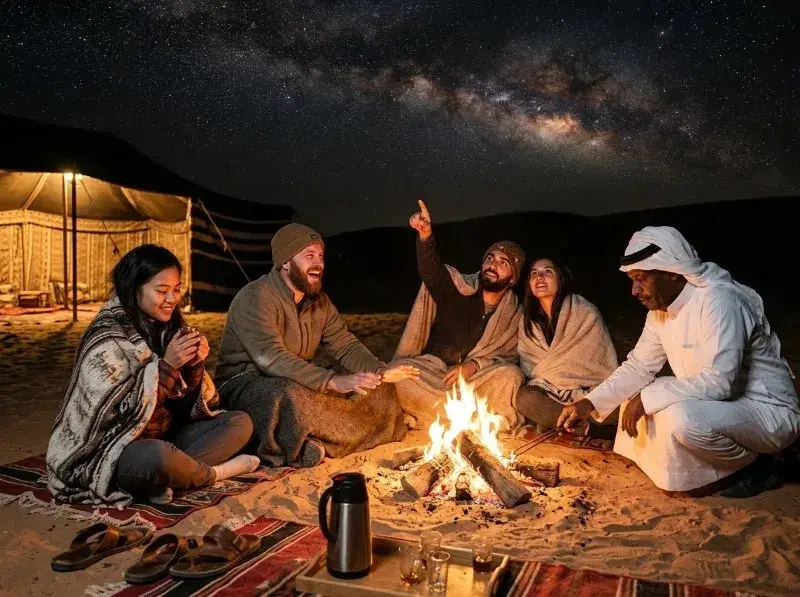
Overnight Desert Safari
The evening, then you stay. Campfire, stars and breakfast at sunrise.
AED 450Sunrise Desert Safari
Out before first light, private car, the best hour of the day.
AED 999 per car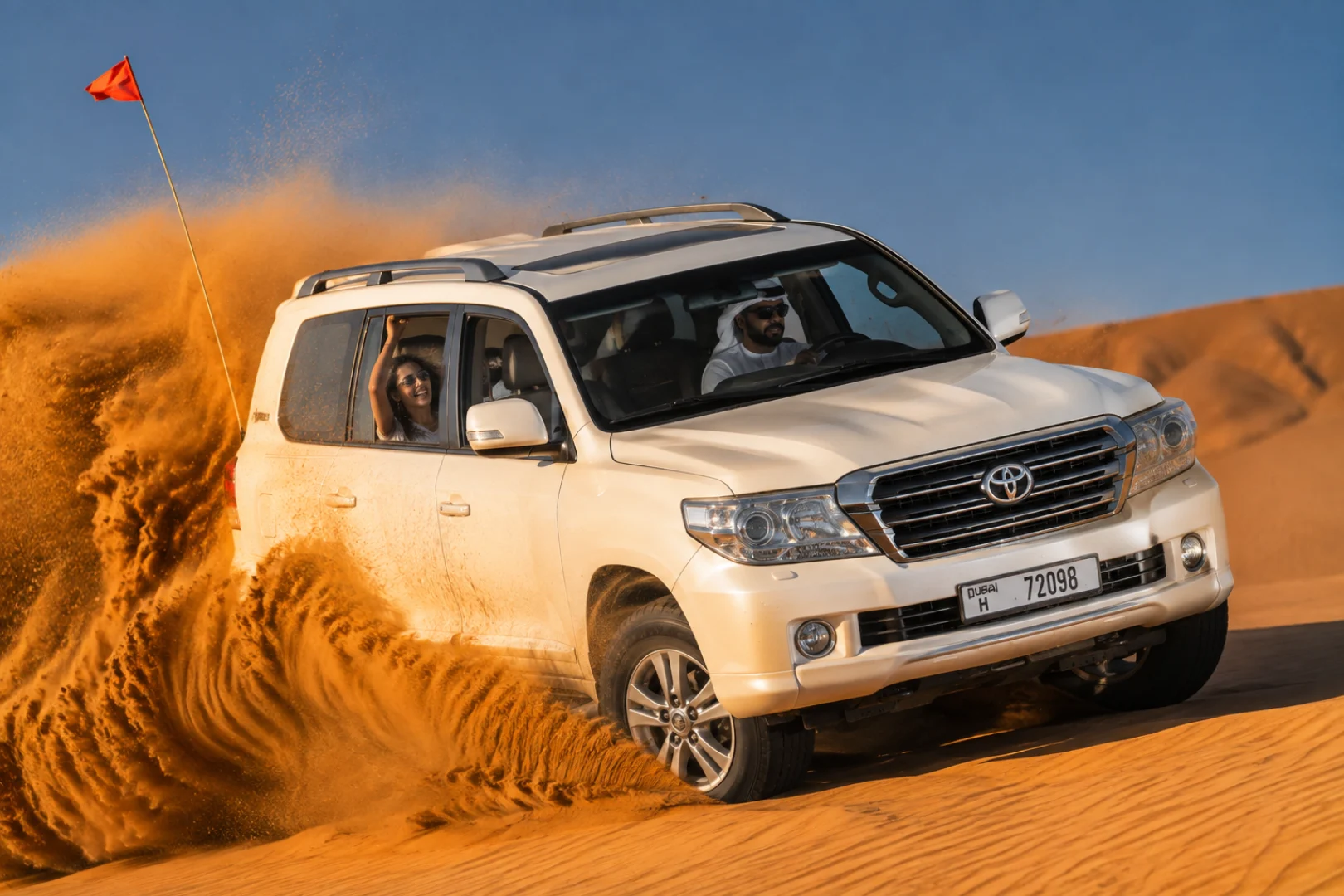
Dune Bashing
Just the drive, if the camp is not what you came for.
from AED 150The morning safari changes a lot with the season
A dawn start in January is the coldest thing we run; the same trip in February is cool and clean and genuinely pleasant. By June and July it only works if you are out at first light and finished before mid-morning. Month by month detail is on the best time to go page and the summer guide.
Tomorrow morning is usually still open
Tell us the date and how many of you there are. A real person replies, usually within a few minutes, whatever the hour where you are. No deposit, no card details, nothing to pay until you reach the camp.
Al Khatim Desert · Abu Dhabi | Pay on arrival · Free cancellation 24h · VAT included