
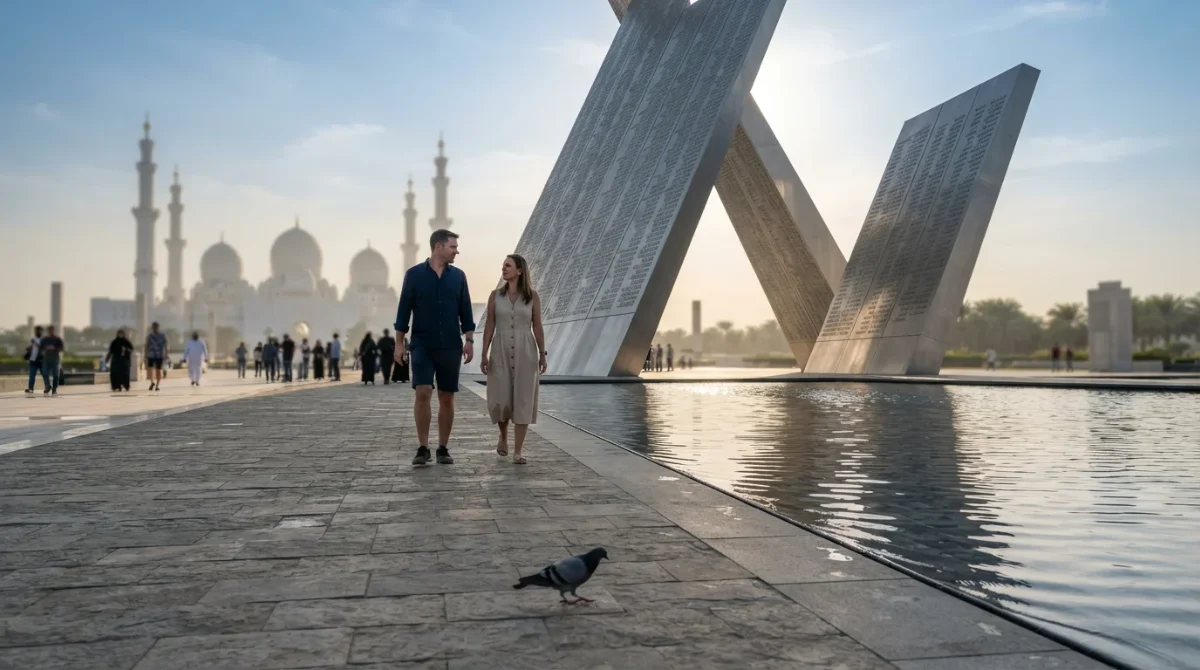
Wahat Al Karama: Twenty Quiet Minutes Opposite the Grand Mosque
The UAE’s memorial to its fallen — vast aluminium tablets leaning on one another, a reflecting pool, and the best view of the mosque in the city. Free, unhurried, and worth doing properly.
- Free to visit
- 20–30 minutes
- Opposite the Grand Mosque
Most visitors discover Wahat Al Karama by accident, looking back across the water from the Grand Mosque and asking what the great leaning slabs are. The answer is the country’s memorial to its fallen servicemen and women — the name means Oasis of Dignity — and it deserves better than being somebody’s zoom photograph.
It costs nothing, takes twenty minutes, and completes the mosque visit in a way no second monument in the city can.
Tablets that hold each other up
The memorial’s centrepiece is a line of massive aluminium-clad tablets, each tilted into the next, so that every one both leans and carries. The design says its meaning without a caption: soldiers support one another; the nation and those who defend it hold each other up.
The tablets bear inscriptions honouring the fallen and the values they served; you do not need Arabic to read the monument itself — the leaning is the text.
Around it, the plaza is deliberately plain: pale stone, open sky, and across the reflecting pool, the domes of the Grand Mosque — placed exactly where the memorial’s sightline wants them.
The quiet room by the water
Beside the plaza stands the Pavilion of Honour, the memorial’s inner room, faced with panels naming the fallen. It is small, cool and very quiet, and it is the part visitors remember.
The reflecting pool between plaza and pavilion does double work: stillness for the memorial, and the mirror in which the mosque appears at dusk — the photograph this page’s hero image shows, taken from the public plaza.
There is no queue culture here and no gift shop. It is the least commercial site in the city, and the calm is the exhibit.
Free, respectful, and best at dusk
Visiting is free, with ordinary daytime-to-evening hours — check locally around public and national holidays, when ceremonies take precedence over tourism, as they should.
Conduct is what you would expect at any nation’s memorial: modest dress, low voices, no posed silliness with the monument. Guards are courteous and will indicate anything not permitted.
Twenty to thirty minutes is the honest visit: the plaza, the pavilion, the pool edge, and a few minutes simply standing. The late-afternoon slot is best — low sun on the aluminium, then the mosque lighting up across the water.
One ticketless afternoon, two sides of the water
The natural plan pairs the memorial with the Grand Mosque, directly opposite: memorial first in the late afternoon, mosque at dusk — the direction the light itself prefers.
Together they cost nothing, take under three hours, and are the most affecting pairing in Abu Dhabi — the spiritual building and the human cost, facing each other across still water.
Our city tour drivers thread the two on request — the stop adds minutes, not hours, to any mosque visit.
The desert road starts right here
The memorial and mosque sit at the city’s exit, where the highway becomes the Al Ain road — the same road that runs to our desert camp at Al Khatim.
Which writes the full day for you: memorial and mosque in the afternoon, then the evening safari outbound on the same road — from AED 35 self-drive to AED 100 collected, dinner and shows included, all options on prices and timings.
Tell us on WhatsApp that you are doing the mosque side first and we will set the pickup to follow it without hurrying either.
Wahat Al Karama — your questions
What is Wahat Al Karama?
The UAE’s memorial to its fallen servicemen and women – a plaza of massive leaning aluminium tablets and a Pavilion of Honour, set directly across the water from the Grand Mosque. The name means Oasis of Dignity.
Is Wahat Al Karama free?
Yes – visiting is free. It keeps ordinary daytime and evening hours; as with every official site, check current times locally around public holidays.
How long does a visit take?
Twenty to thirty unhurried minutes. It is a place of reflection rather than an attraction – you walk the plaza, read the monument’s idea, and take in the mosque view across the pool.
Why do the tablets lean on each other?
That is the design’s meaning: each massive tablet supports the others – soldiers supporting one another, and country and soldier supporting each other in turn. It reads instantly, which is why the memorial works.
What should visitors keep in mind?
It is a working national memorial: dress modestly, keep voices low, and treat photography the way you would at any country’s memorial. Guards will politely indicate anything not permitted.
When is the best time to visit?
Late afternoon into dusk, timed with a Grand Mosque visit across the water – the tablets catch the low sun, and the mosque lights up across the pool as the light goes.
Read next
Across the water: the Grand Mosque, visited properly. The wider day: the city tour and the full-day route. And the road both sites stand on leads to the evening desert safari.
The mosque, the memorial, and the road to the dunes
One afternoon covers all three, in the order the light prefers. Tell us your date — the city part costs nothing, and the desert evening starts at AED 35.