
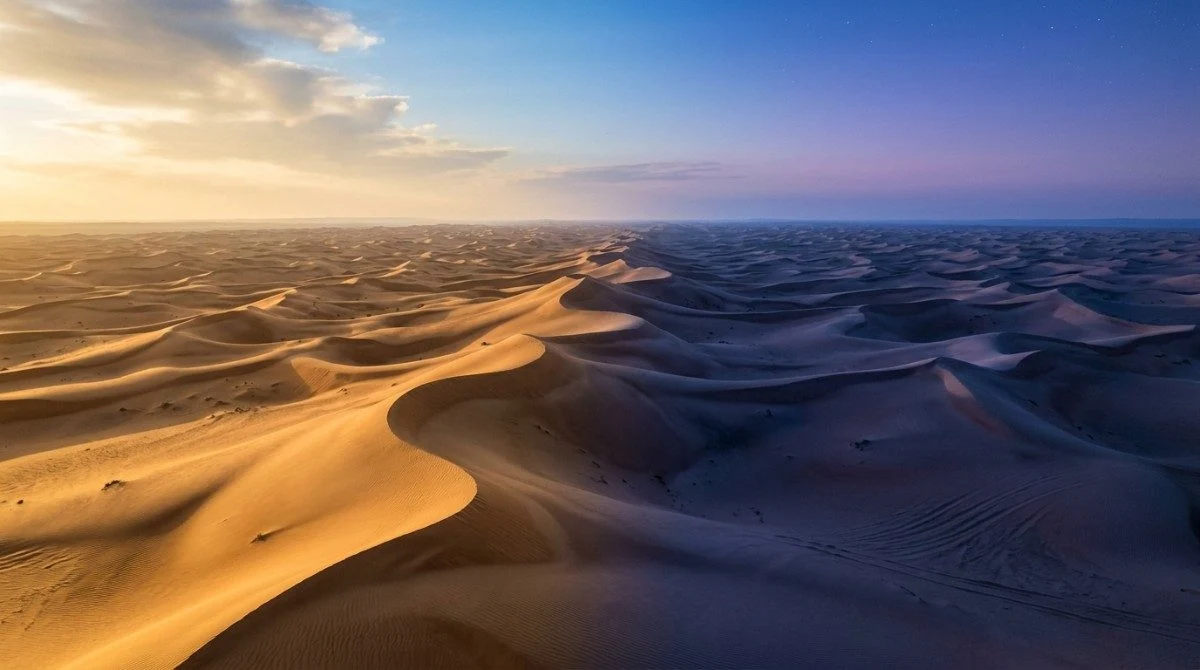
The Best Time for a Desert Safari in Abu Dhabi
Twelve months, official climate normals, real sunset times and an honest note on what each one is good for. The trip runs every night of the year — this is how to choose which night.
- 9 min read
- Al Khatim Desert
- Runs every day
- Same price all year
Almost every page you will find on this question answers it with one word and a photograph. The honest answer is that it depends what you want, because the twelve months here differ far more than the phrase “year-round sunshine” suggests.
The table below is the whole year in one place, taken from official Abu Dhabi climate normals rather than from other tour sites. Underneath it, the short version for the four things people are actually choosing between: comfort, stars, quiet and light.
Every month, side by side
Average daytime high, average overnight low, monthly rainfall and the sunset window, from the first day of the month to the last. Click any month for the full guide.
| Month | Day | Night | Rain | Sunset window | What it is good for |
|---|---|---|---|---|---|
| January | 24.5°C | 13.8°C | 12.5 mm | 5:46 – 6:07 PM | Coldest nights, clearest air |
| February | 26.5°C | 15.9°C | 8.1 mm | 6:08 – 6:24 PM | The most even month of the year |
| March | 29.7°C | 17.5°C | 12.9 mm | 6:25 – 6:38 PM | Last month that works all day |
| April | 35.0°C | 21.1°C | 5.2 mm | 6:39 – 6:51 PM | Best evening, worst midday |
| May | 39.6°C | 24.6°C | 0.3 mm | 6:52 – 7:06 PM | Driest air, quiet camps |
| June | 41.4°C | 26.9°C | 0.0 mm | 7:07 – 7:15 PM | Longest days, latest sunset |
| July | 42.5°C | 29.7°C | 0.7 mm | 7:15 – 7:07 PM | Desert drier than the coast |
| August | 43.4°C | 30.2°C | 0.1 mm | 7:06 – 6:42 PM | The hottest month of all |
| September | 40.9°C | 27.4°C | 0.0 mm | 6:41 – 6:11 PM | The turn out of summer |
| October | 36.6°C | 23.7°C | 0.2 mm | 6:10 – 5:44 PM | The season reopens |
| November | 31.0°C | 19.6°C | 2.4 mm | 5:43 – 5:33 PM | Everything works at once |
| December | 26.5°C | 15.7°C | 7.8 mm | 5:34 – 5:45 PM | The fire earns its place |
Two things stand out when you read the table as a whole. The night column swings by more than sixteen degrees across the year, from 13.8°C in January to 30.2°C in August — and since you spend most of a safari after dark, that column matters more than the daytime one. And the sunset column moves by more than an hour and a half, which changes the entire shape of the evening.
The short version, for the four things people actually want
For the most comfortable evening: February. 26.5°C by day and 15.9°C at night is the narrowest gap on the calendar. You dress once and never think about it again.
For the clearest sky: January. The cleanest air of the year, and a properly dark sky by dinner. Bring a real jacket — it is also the coldest month.
For the emptiest desert: June. The quietest camps we run, the longest golden hour of the year, and same-day booking is usually fine. The trade is a 41.4°C afternoon.
For the whole day, not just the evening: March. The last month where 29.7°C lets you use the daylight as well.
For sea and sand in the same trip: April. The only month where the water is genuinely swimmable at about 25°C and the evening still drops to 21°C.
There are really only two seasons here
Forget spring and autumn. The Abu Dhabi desert year splits into two, and the dividing line is whether the afternoon is usable.
| October – April | May – September | |
|---|---|---|
| The afternoon | Comfortable to warm | Genuinely hot; nothing outdoors |
| The evening | Cool to mild — a layer needed | Warm; no layer at all |
| Air | Clear, dry, sharp horizons | Hazy from the shamal, humid on the coast |
| Rain | A little, November to April | Effectively none |
| Camps | Filling to full | Quiet to empty |
| Sunset | 5:33 PM to 6:51 PM | 6:42 PM to 7:15 PM |
| Stargazing | The whole window | Haze, and late darkness |
The important thing that table does not say is that summer is a bad time to come. The safari is an evening trip in every month of the year. What summer changes is the packing list, the crowd and the character of the night — not whether it runs.
Best months for the night sky
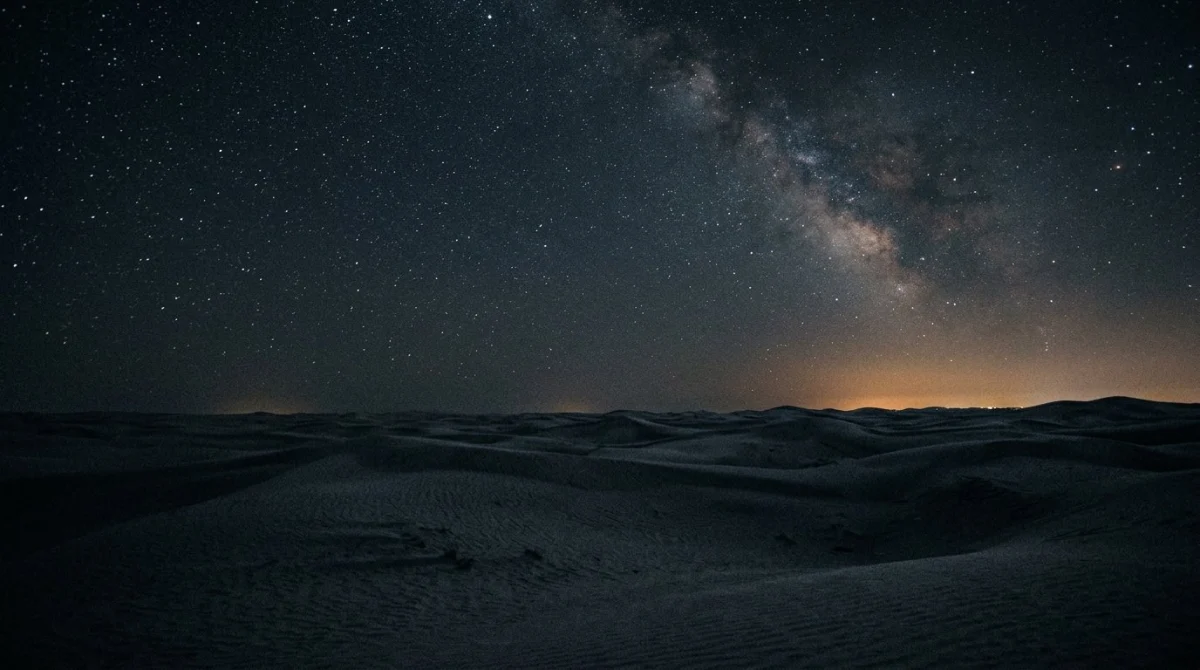
The clear-sky window runs October to March. There is no winter dust season — the shamal belongs to early summer — and no heat haze coming off the sand, so the sky goes properly black once the sun is down.
Within that window there is one month that stands apart, and it is not the one people expect. October averages 23.7°C at night, which is the only figure in the whole window warm enough to lie back on the sand without a jacket. November is 19.6°C, December 15.7°C, January 13.8°C. The sky in January is marginally cleaner; the evening in October is far more pleasant to spend looking at it.
The other lever is sunset. In December the sky is dark by half past six; in June it is not dark until well after eight. If you want stars without a late night, the winter months hand them to you early. More on the stargazing guide.
Best months for an empty desert
If a previous safari left you feeling processed, it was almost certainly a December or January weekend. The same camp in June is a different place.
| Months | How full | What that changes |
|---|---|---|
| June and July | Emptiest of the year | Same-day booking; a longer dune session; the ridge to yourself |
| May and September | Very quiet | No queue for the camel, quad or henna |
| August | Quiet, but the hottest month | Empty, and 43.4°C in the afternoon |
| October and November | Filling steadily | Book two to three days ahead |
| February and March | Consistently full | Two to three days; a week for a private car |
| Late December, first week of January | The tightest of the year | Book well ahead; weekends go first |
Best months for photographs
For landscape and long-distance work: December through February. No haze, no heat shimmer, low sun all afternoon and raking shadows across the ripples. Distant ridgelines stay sharp in a way they simply do not in summer.
For the longest golden hour: April to June. Sunset between 6:39 and 7:15 PM with a long, slow approach to it.
For blue hour with the camp lit: December and January. An early sunset means colour is still in the sky while the camp lights are on — the shot most guests miss because they are queuing for the buffet.
Worst months: June to August. Shamal haze softens everything at distance. Close work is fine; the wide shot is not.
Best months with children
Two things decide this, and neither is the temperature.
Bedtime versus the stars. In winter the sun is down before six, so a young child sees a full starfield with dinner still in front of them. In June the sun is up until 7:15 PM and full dark arrives after eight thirty, by which point most small children are asleep in the car. If the night sky is part of why you are going, book October to March.
The sand you can touch. From November to March the surface stays cool all evening, which matters enormously for children who will spend the night sitting in it, rolling down it and falling off a sandboard into it. In July the sand holds heat long after sunset.
Age limits, car-seat rules and the practical detail are on the family safari page.
When you need to book ahead
The pressure points are narrower than people expect. Most of the year, two or three days is plenty.
| Window | How far ahead |
|---|---|
| Late December and New Year | A week or more; weekends first |
| UAE National Day, early December | Several days |
| Eid holidays, wherever they fall | A week — this is the one period shared vehicles genuinely sell out |
| February and March weekends | Three to four days |
| Any weekday, October to April | Two days is usually fine |
| May to September | Same day or next day, weekends included |
Nothing is charged in advance and cancellation is free up to twenty-four hours before pickup, so holding a date early costs you nothing.
What it costs, in any month
This is the part where most seasonal guides get vague. Our prices do not move with the season at all — there is no peak surcharge, no holiday premium and no low-season discount.
| How you travel | Price | Unit |
|---|---|---|
| Self-drive to the camp | AED 35 | per person |
| Shared bus from Al Wahda or Mazyad Mall | AED 50 | per person |
| Hotel pickup, shared vehicle | AED 100 | per person |
| Private car, up to seven guests | AED 599 | per car |
| Private Land Cruiser | AED 800 | per car |
| Morning safari, private | AED 799 | per car |
Add-ons at the camp: quad bike AED 100 single or 150 double, VIP majlis seating AED 50 per person, long camel ride AED 300, falcon photo AED 30, extra dune bashing AED 150 per vehicle.
No deposit and no card details. You pay on arrival, cash or card, and you can cancel free up to twenty-four hours before pickup.
The questions we get asked most about timing
What is the best month for a desert safari in Abu Dhabi?
February, on balance. It has the narrowest gap between afternoon and night of any month — 26.5°C down to 15.9°C — so nothing about the evening needs managing. January is better for stargazing and photography, March is better if you want the daytime too, and April has the finest evening light. There is no bad month; there are months that suit different things.
What is the best time of year to visit the Abu Dhabi desert?
October to April. The camp is comfortable after dark, the air is clear, and the afternoon is bearable. Within that, November to March is the core season. May to September still runs every night and has its own advantages — empty dunes, dry inland air and the latest sunsets — but it is strictly an evening trip.
Is a desert safari worth it in summer?
Yes, if you go in the evening. The trip runs every day of the year. In July and August the inland desert is considerably drier than the coast, so a camp evening is often more comfortable than a seafront one, and the camps are close to empty. What summer does not suit is anyone wanting a cool night or sharp long-distance photographs.
Which month has the best stargazing?
October through March, once the summer haze has gone. Within that window, October is the only month with nights warm enough to lie on the sand without a jacket at 23.7°C. January has the very clearest air but the coldest nights at 13.8°C.
Which month is quietest?
June and July. Same-day bookings are usually possible, the dunes are empty and the dune session runs longer because there are fewer vehicles. May and September are close behind.
Which month is busiest?
Late December and the first week of January, followed by the whole of February and March. National Day at the start of December and the New Year window are the two tightest points on the calendar.
Does the price change with the season?
No. Every package costs the same in January as in July. There is no peak-season surcharge, no weekend premium and no low-season discount. What changes across the year is the pickup time and what you should pack.
When is it too hot for a desert safari?
Never for the evening trip, and always for the middle of the day between about May and September. Pickup is at three in the afternoon, so even in August the hottest hour is spent inside an air-conditioned vehicle. What we will not do in summer is run a midday activity.
When does it rain in Abu Dhabi?
Between November and April, and barely then. March is the wettest month at 12.9 mm and January is close behind at 12.5 mm — both roughly three days of light rain. From May to October rainfall is effectively zero.
Which month should I book with children?
October to March, if the stars matter. Winter sunsets before six o’clock mean a young child sees a full night sky with dinner still on the plate. In June the sun is up until 7:15 PM and most small children are asleep before the sky goes properly dark.
Tell us your dates and we will tell you what that month is actually like
Send the date, the package and how many of you there are. A real person replies, usually within a few minutes. If the month you have picked is wrong for what you want, we will say so.
Al Khatim Desert · Abu Dhabi | Pay on arrival · Free cancellation · No deposit