
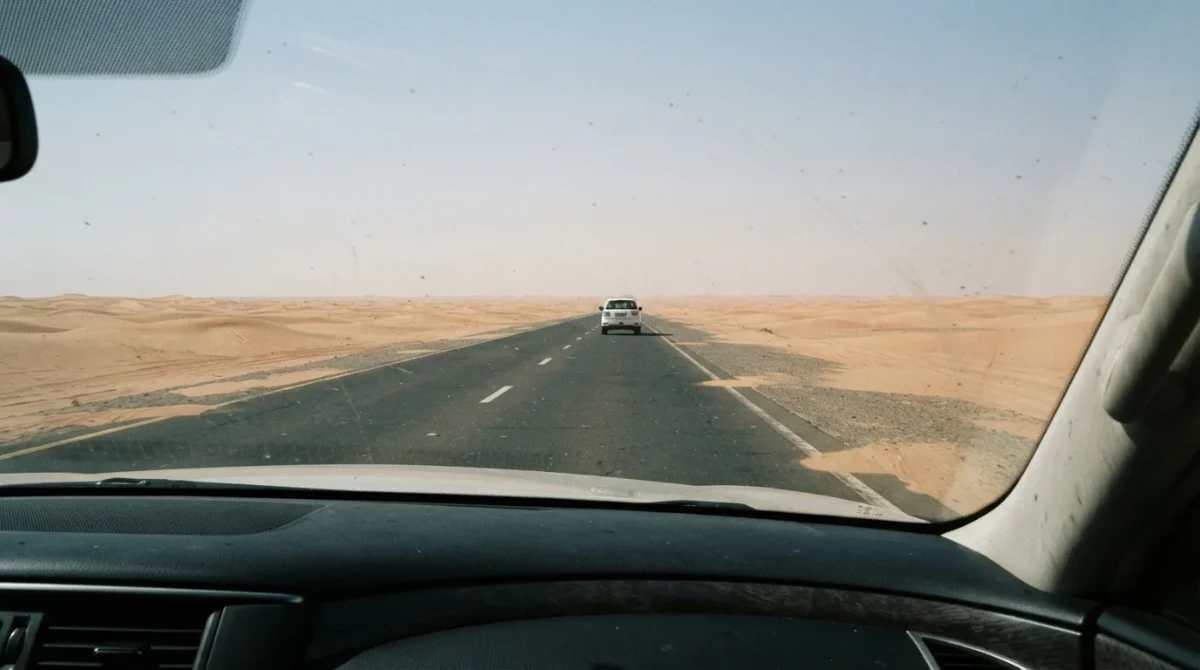
Roadworks, Fog and a New Speed Limit: The Drive to the Desert Right Now
Three things have changed on the road to our camp this month. None of them stops a safari. All of them change what time you should leave.
- E75 works through Al Ajban and Sweihan
- E311 now 100 km/h, no grace buffer
- Fog possible each morning to 20 September
Most desert safari blogs never mention the road. They describe the dunes and the dinner and leave you to work out the ninety minutes in between. That is a poor omission this month, because the drive east of Abu Dhabi has changed in three separate ways.
Here is what happened, where each fact came from, and what we are actually doing about it. If you read one line only: evening trips are unaffected, morning trips need an earlier start.
The E75 works, and why they matter to us
On 9 September, closures and heavy congestion were reported on the E75 between Khalifa Industrial City B and the Sweihan area, passing through Al Ajban and Niqa Al Dheeb, with a separate closure near Khatm Al Shiklah on the Al Ain to Oman road. No end date was given.
A week later there is still no announcement either way. The traffic bulletins on 14 and 15 September do not mention those closures at all, but they do report heavy delays on Sweihan Road near Al Falah. We are treating the works as ongoing until somebody says otherwise, and we would rather tell you that than guess.
That corridor is not incidental to us. It is the road that carries almost everyone out to the Sweihan desert and on to Al Khatim, where our camp sits. We have added fifteen to twenty minutes to city pickups since the ninth. Nobody has missed a sunset. If you are driving yourself, open your map app while you are still parked, not at the first diversion sign.
The E311 is now 100, and there is no grace buffer
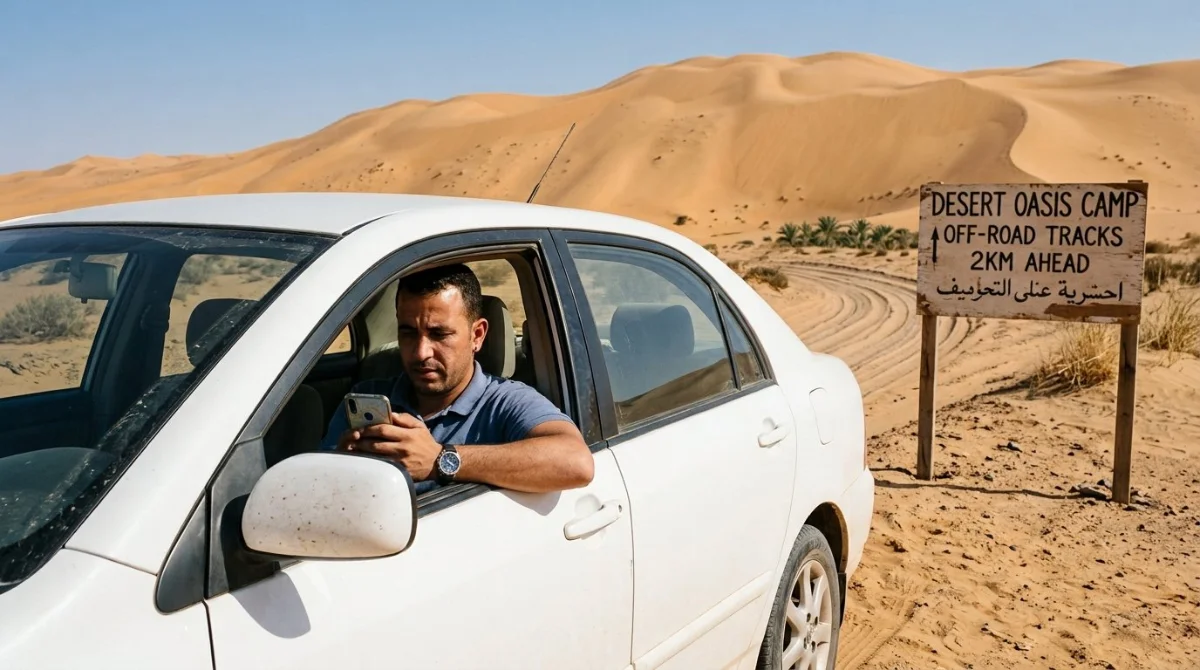
From Monday 14 September the limit on a roughly six-kilometre stretch of Sheikh Mohammed bin Rashid Al Maktoum Road, the E311, dropped from 120 km/h to 100 km/h in both directions. The section runs between the Tawi Al Qaymah and At Turoush Street junctions and the Al Khayr Street interchange; heading towards Dubai, Baniyas Cemetery is the landmark.
Worth knowing if you are new to driving here: Abu Dhabi does not apply a tolerance margin. In a 100 zone, 101 is a violation, and fines run from Dh300 upward depending on how far over you are. Visitors used to the old buffer get caught by this more than anyone.
| Change | Where | What it means for you |
|---|---|---|
| E75 works | Khalifa Industrial City B to Sweihan, via Al Ajban | Add 15–20 minutes, check for diversions |
| E311 limit 120 → 100 | Tawi Al Qaymah / At Turoush to Al Khayr Street, about 6 km | A few minutes more on the city leg, in force now |
| Fog speed rule | Anywhere visibility falls below 1 km | Limits drop to 80 km/h until it lifts |
None of this is dramatic on its own. Together it adds up to about half an hour on a morning run, which is the difference between a relaxed start and a rushed one.
Fog is back, and our corridor is the one it likes
The National Center of Meteorology bulletin issued on 16 September carries the same line every day to the twentieth: humid by night and early morning over some coastal and internal areas, with a chance of fog or mist forming. Humidity is running between 60 and 95 per cent. That is the recipe, and it will keep repeating now until the spring.
NCM has been consistent about where the risk concentrates, and it is the open desert corridors linking Abu Dhabi, Al Ain and Dubai. Our road, again. When visibility drops below a kilometre the speed limit falls to 80 km/h until it clears.
What this does to a booking is narrower than it sounds. Evening safaris are untouched, because the fog has burned off long before an afternoon pickup. Morning and sunrise trips are the ones to plan around, and the answer is to start earlier, not to drive faster. We have never cancelled a trip for fog. We have moved plenty of them by twenty minutes.
It is still properly hot out there
NCM puts inland maximums at 41 to 46°C this week, with the coast at 38 to 43°C. On 15 September the country’s high was 45.4°C, recorded at Bada Dafas in Al Dhafra. Anyone telling you mid-September is the cool season has not stood on a dune at two in the afternoon.
But an evening safari is governed by the overnight low, not the headline high, and the low is what moves first. Abu Dhabi averages 40.9°C by day and 27.4°C at night in September, against 36.6°C and 23.7°C in October. The days give up about four degrees. The nights give up nearly as much, and they give it up sooner.
By the time dinner is served at the camp, the difference between now and a fortnight ago is already there. Our September page has the month in full.
Sunset is walking backwards faster than you think
Tonight the sun sets at 6:26 PM. On 30 September it sets at 6:11 PM, and by 31 October at 5:44 PM. That is three quarters of an hour of evening gone in six weeks, and right now daylight is shrinking at close to a minute and a half a day, about as fast as it ever does here.
The September equinox falls just after four in the morning, UAE time, on 23 September. A small pedantry worth knowing: day and night are not exactly equal on the equinox in Abu Dhabi. They come out at twelve hours and seven minutes, because sunrise and sunset are measured from the top edge of the sun and the atmosphere bends the light over the horizon. The genuinely equal day here lands around 28 September.
On a dune this matters in one practical way. After sunset you get roughly twenty minutes of usable light before it is properly dark, and that window is shrinking too. Pickup times move with the sun, so check the current timings rather than a figure you read in July.
October is the better month, and we will say so
We would rather tell you this than take the booking and have you spend the afternoon in the shade of a vehicle. If you can move your trip, move it to October.
- It is four degrees cooler by day and nearly four by night. That is the single biggest change in the whole calendar.
- The sky gets better. Saturn reaches opposition on 4 October, so it is up all night and at its brightest. The new moon on 10 October gives genuinely dark evenings from roughly 4 to 16 October, the best stargazing window of the autumn. Late September is moonlit and disappointing.
- The Draconid meteors peak on the evening of 8 to 9 October. Modest, about ten an hour, but unusual in being best in the early evening rather than after midnight, which suits a safari perfectly.
- Al Wasm begins in mid-October — the traditional Emirati season of moderate weather and the first rains, and the one the old calendar treats as the good half of the year beginning.
- One warning: UAE schools break from 10 to 18 October. That week is the busiest domestic window before winter. Book earlier than you normally would.
The October page has the detail. Our prices do not change between the two months. We are not cheaper in September and we will not pretend to be.
What to do about all this, this week
- Booked an evening safari? Do nothing. The roadworks are a minor delay and the fog is long gone by afternoon.
- Booked a morning or sunrise trip? Expect us twenty minutes earlier than the old schedule, and set an alarm accordingly.
- Driving yourself? Self-drive is still AED 35 a head at the camp. Watch the new E311 limit, and do not try to make up time on the Sweihan road — it is a single carriageway with camels on it.
- Want collecting instead? Hotel and home pickup is running normally, and our drivers know the diversions better than any app does.
- Not sure? Message us the night before. We will tell you what the road looked like that morning.
Common questions this week
Are the E75 roadworks stopping desert safaris?
No. Closures and congestion were reported on 9 September between Khalifa Industrial City B and Sweihan, with no end date and no update since. The route to the camp remains open. We have added fifteen to twenty minutes to pickups.
Will fog cancel my morning safari?
It has not yet. NCM flags a chance of fog or mist most mornings through 20 September. When visibility drops below a kilometre the speed limit falls to 80 km/h, so we start earlier rather than drive faster. Evening trips are unaffected.
Does the new E311 speed limit change my pickup time?
Only by a few minutes. Since Monday 14 September the limit on about six kilometres of the E311, between the Tawi Al Qaymah and At Turoush junctions and the Al Khayr Street interchange, is 100 km/h instead of 120. It is already built into our schedule.
Is mid-September too hot for a desert safari?
Not for an evening trip, which runs on the overnight low rather than the afternoon high. Inland maximums are 41 to 46 degrees this week, so a midday dune walk is a bad idea, but by the time dinner is served at the camp it is comfortable.
What time does the evening safari start now?
Pickups move with sunset, which is 6:26 PM on 16 September and 6:11 PM by the end of the month. Check the timings page for the current window rather than relying on a summer schedule.
Should I just wait until October?
If your dates are flexible, yes. October is about four degrees cooler day and night, the darkest stargazing nights fall between 4 and 16 October, and Saturn is at its brightest. Avoid 10 to 18 October if you dislike crowds, as UAE schools are on holiday.
Tell us your date and we will tell you the road
We answer on WhatsApp, usually within a few minutes. No deposit, and you can cancel up to twelve hours before.